and the mixer controls were shown with the headphones plugged in or without?
I’ve played around with alsamixer…and got it working. Removed the plug, enabled auto mute, disabled it and plugged in again. Now headphones are working and the internals are muted even alsa tells auto mute is off. Alsamixer Screenshot and amixcer -c 0 output, maybe you can puzzle that out.
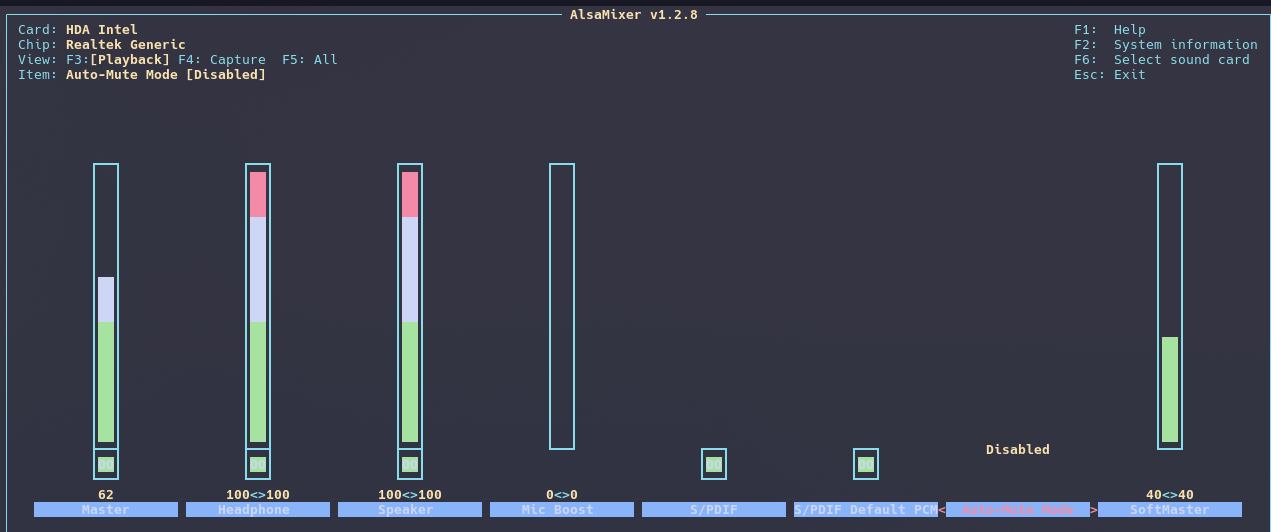
$ amixer -c 0
Simple mixer control ‘Master’,0
Capabilities: pvolume pvolume-joined pswitch pswitch-joined
Playback channels: Mono
Limits: Playback 0 - 87
Mono: Playback 72 [83%] [-11.25dB] [on]
Simple mixer control ‘Headphone’,0
Capabilities: pvolume pswitch
Playback channels: Front Left - Front Right
Limits: Playback 0 - 87
Mono:
Front Left: Playback 87 [100%] [0.00dB] [on]
Front Right: Playback 87 [100%] [0.00dB] [on]
Simple mixer control ‘Speaker’,0
Capabilities: pvolume pswitch
Playback channels: Front Left - Front Right
Limits: Playback 0 - 87
Mono:
Front Left: Playback 87 [100%] [0.00dB] [on]
Front Right: Playback 87 [100%] [0.00dB] [on]
Simple mixer control ‘Mic Boost’,0
Capabilities: volume
Playback channels: Front Left - Front Right
Capture channels: Front Left - Front Right
Limits: 0 - 3
Front Left: 0 [0%] [0.00dB]
Front Right: 0 [0%] [0.00dB]
Simple mixer control ‘IEC958’,0
Capabilities: pswitch pswitch-joined
Playback channels: Mono
Mono: Playback [on]
Simple mixer control ‘IEC958 Default PCM’,0
Capabilities: pswitch pswitch-joined
Playback channels: Mono
Mono: Playback [on]
Simple mixer control ‘Capture’,0
Capabilities: cvolume cswitch
Capture channels: Front Left - Front Right
Limits: Capture 0 - 31
Front Left: Capture 19 [61%] [12.00dB] [on]
Front Right: Capture 19 [61%] [12.00dB] [on]
Simple mixer control ‘Auto-Mute Mode’,0
Capabilities: enum
Items: ‘Disabled’ ‘Enabled’
Item0: ‘Disabled’
Simple mixer control ‘SoftMaster’,0
Capabilities: volume
Playback channels: Front Left - Front Right
Capture channels: Front Left - Front Right
Limits: 0 - 99
Front Left: 59 [60%]
Front Right: 59 [60%]
It’s a bit of a lotto with this auto switching, perhaps you were just lucky with 4.062. Pity I don’t have a notebook or desktop with an HDA Intel soundcard, it is extremely difficult to debug this without it. It needs jack event handling, which was not implemented for this card. No promises, but I will see whether I can modify the ‘handle_jack-headphone_event’ script, when you are willing to test it.
Thank you very much.
Of course I am willing to test  Best way to give something back to everyone
In the meantime I’ve booted from a clean Volumio 4.067 install, that issue is there, too.
If you need anything or if you’d like me to test something, let me know.
Hi.
Volumio3.874 instaled on wyse 3040 x86. Wifi connected to router but not joinable. I can open webgui over wifi only when I conect LAN for 5 sec. I can disconnect LAN and connection is stable - internet radio is working. After reboot - same procedure is needed. Funny thing same procedure works when connecting volumio to my iphone hotspot - volumio need LAN for few sec. /diferent nettwork/ and its working via iphone hotspot. Any idea how to fix it?
Which version of Volumio are you running and don’t say the latest?
 latest… see my post 3.874 after update -tested. And btw static adrress for wifi - tested, hotspot off - tested, reset to factory - tested, dns - tested. same issue.
Yeah, totally missed the version in your post 
Please see openings post and provide what is asked under:
**  Reporting**
We’ve seen issues with some adapters on V4, which is being fixed. However V3.xxx should be pretty stable.
Hi @gkkpch! Apologies for the long time that has passed, But I’ve recently had a newborn to take care of, which can be time consuming 
I got back to this topic just to realize that Volumio 4 was released in the meantime, so congrats for that! I’ve tried to do a fresh install with the same hardware and it now looks like the driver has changed on Volumio 4. If you recall, previously, I got a lot of mixer options, where as now I only get the following:
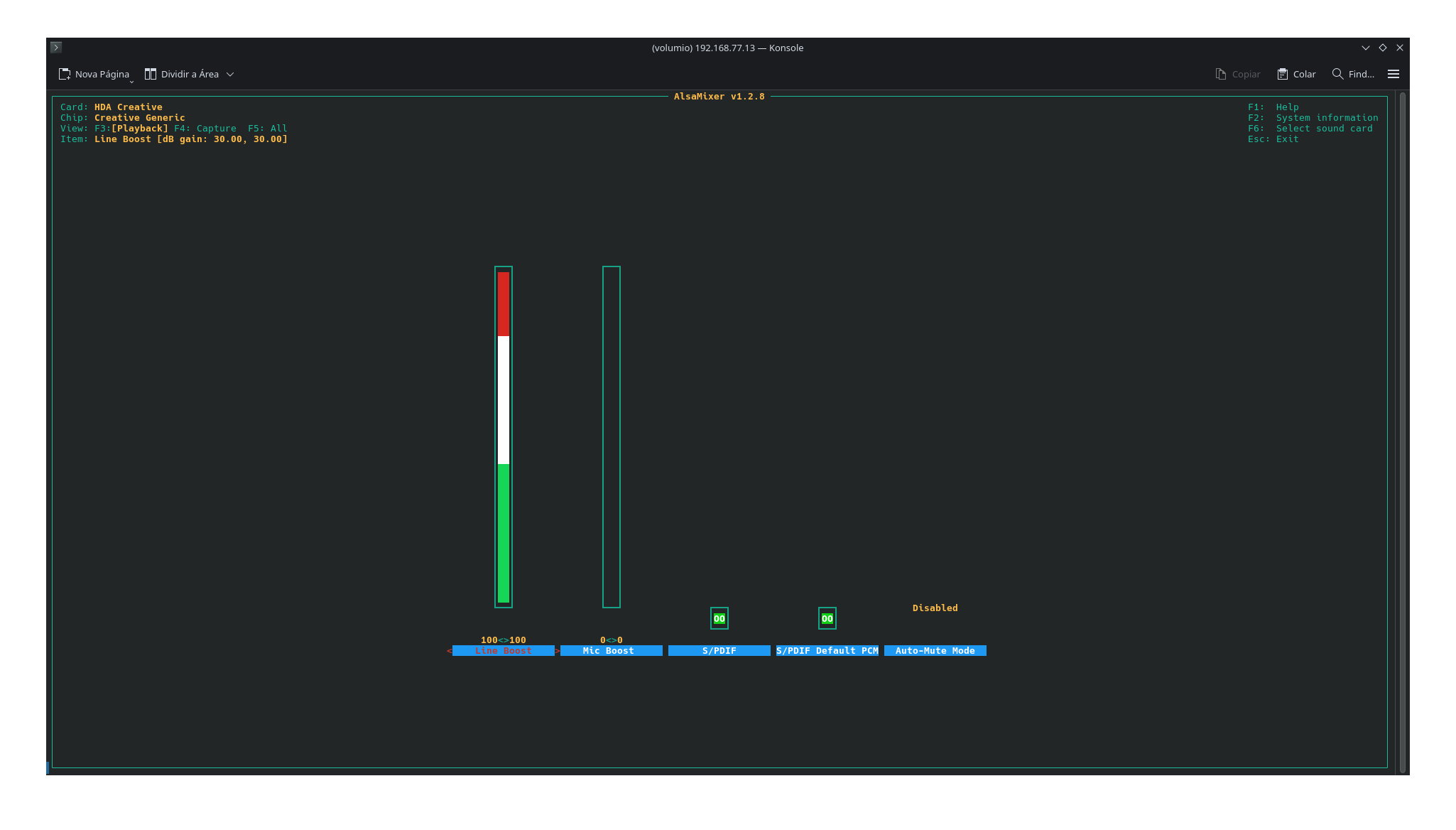
I can’t properly control my sound card, so I can’t get any audio on the analog output, regardless of me installing alsa-firmware-loaders and/or alsa-firmware-1.2.4
The cards.json file now has the proper spec for this card, where it identifies the two devices, so that part seems to be fine though.
Any idea on what could’ve changed?
Congratulations!
Without a log I can’t help, just guess and I’m not so good at that
There you go: http://logs.volumio.org/volumio/QYeT4sx.html
Also:
volumio@gm-volumio:~$ aplay -l
**** List of PLAYBACK Hardware Devices ****
card 0: Creative [HDA Creative], device 0: Generic Analog [Generic Analog]
  Subdevices: 1/1
  Subdevice #0: subdevice #0
card 0: Creative [HDA Creative], device 1: Generic Digital [Generic Digital]
  Subdevices: 1/1
  Subdevice #0: subdevice #0
volumio@gm-volumio:~$ inxi -Fxxxz
System:
  Kernel: 6.12.57-volumio arch: x86_64 bits: 64 compiler: gcc v: 13.3.0 Console: pty pts/0
    Distro: Debian GNU/Linux 12 (bookworm)
Machine:
  Type: Kvm System: QEMU product: Standard PC (i440FX + PIIX, 1996) v: pc-i440fx-10.0
    serial: <superuser required> Chassis: type: 1 v: pc-i440fx-10.0 serial: <superuser required>
  Mobo: N/A model: N/A serial: N/A BIOS: SeaBIOS v: 1.16.3-debian-1.16.3-2~bpo12+1
    date: 04/01/2014
CPU:
  Info: dual core model: Intel Core (Skylake IBRS) bits: 64 type: MCP smt: <unsupported>
    arch: Skylake-S rev: 3 cache: L1: 128 KiB L2: 8 MiB L3: 16 MiB
  Speed (MHz): avg: 3192 min/max: N/A cores: 1: 3192 2: 3192 bogomips: 12767
  Flags: avx avx2 ht lm nx pae sse sse2 sse3 sse4_1 sse4_2 ssse3 vmx
Graphics:
  Device-1: Red Hat QXL paravirtual graphic card driver: qxl v: kernel ports: active: Virtual-1
    empty: Virtual-2,Virtual-3,Virtual-4 bus-ID: 00:02.0 chip-ID: 1b36:0100 class-ID: 0300
  Display: server: X.org v: 1.21.1.7 driver: X: loaded: modesetting unloaded: fbdev,vesa
    gpu: qxl tty: 110x28
  Monitor-1: Virtual-1 size-res: N/A in console modes: max: 1280x720 min: 640x480
  API: OpenGL Message: GL data unavailable in console and glxinfo missing.
Audio:
  Device-1: Creative Labs CA0132 Sound Core3D [Sound Blaster Recon3D / Z-Series BlasterX AE-5
    Plus] driver: snd_hda_intel v: kernel pcie: speed: 2.5 GT/s lanes: 1 bus-ID: 00:07.0
    chip-ID: 1102:0012 class-ID: 0403
  API: ALSA v: k6.12.57-volumio status: kernel-api
Network:
  Device-1: Intel 82371AB/EB/MB PIIX4 ACPI vendor: Red Hat Qemu virtual machine
    type: network bridge driver: piix4_smbus v: N/A port: N/A bus-ID: 00:01.3 chip-ID: 8086:7113
    class-ID: 0680
  Device-2: Red Hat Virtio network driver: virtio-pci v: 1 port: c0a0 bus-ID: 00:03.0
    chip-ID: 1af4:1000 class-ID: 0200
  IF: eth0 state: up speed: -1 duplex: unknown mac: <filter>
Drives:
  Local Storage: total: 10 GiB used: 1.28 GiB (12.8%)
  ID-1: /dev/sda vendor: QEMU model: HARDDISK size: 10 GiB speed: 1.5 Gb/s type: N/A
    serial: <filter> rev: 2.5+ scheme: GPT
Partition:
  ID-1: /boot size: 365.2 MiB used: 91 MiB (24.9%) fs: vfat dev: /dev/sda1
Swap:
  Alert: No swap data was found.
Sensors:
  Src: /sys Message: No sensor data found in /sys/class/hwmon.
Info:
  Processes: 177 Uptime: 17h 33m wakeups: 96 Memory: 3.84 GiB used: 792 MiB (20.1%) Init: systemd
  v: 252 target: graphical (5) default: graphical Compilers: gcc: 12.2.0 alt: 12 Packages:
  pm: dpkg pkgs: 903 Shell: Bash v: 5.2.15 running-in: pty pts/0 (SSH) inxi: 3.3.26
Also got this:
volumio@gm-volumio:~$ journalctl -b | grep hda
Nov 24 13:26:10 gm-volumio kernel: snd_hda_intel 0000:00:07.0: Disabling MSI
Nov 24 13:26:10 gm-volumio kernel: snd_hda_intel 0000:00:07.0: Force to non-snoop mode
Nov 24 13:26:10 gm-volumio kernel: snd_hda_codec_generic hdaudioC0D1: autoconfig for Generic: line_outs=1 (0xb/0x0/0x0/0x0/0x0) type:line
Nov 24 13:26:10 gm-volumio kernel: snd_hda_codec_generic hdaudioC0D1:    speaker_outs=0 (0x0/0x0/0x0/0x0/0x0)
Nov 24 13:26:10 gm-volumio kernel: snd_hda_codec_generic hdaudioC0D1:    hp_outs=1 (0x10/0x0/0x0/0x0/0x0)
Nov 24 13:26:10 gm-volumio kernel: snd_hda_codec_generic hdaudioC0D1:    mono: mono_out=0x0
Nov 24 13:26:10 gm-volumio kernel: snd_hda_codec_generic hdaudioC0D1:    dig-out=0xc/0xd
Nov 24 13:26:10 gm-volumio kernel: snd_hda_codec_generic hdaudioC0D1:    inputs:
Nov 24 13:26:10 gm-volumio kernel: snd_hda_codec_generic hdaudioC0D1:      Mic=0x12
Nov 24 13:26:10 gm-volumio kernel: snd_hda_codec_generic hdaudioC0D1:      Line=0x11
Nov 24 13:26:10 gm-volumio kernel: snd_hda_codec_generic hdaudioC0D1:    dig-in=0xe
Nov 24 13:26:49 gm-volumio kernel: snd_hda_intel 0000:00:07.0: IRQ timing workaround is activated for card #0. Suggest a bigger bdl_pos_adj.
“snd_hda_codec_generic” is being loaded instead of “snd_hda_codec_ca0132”, for some reason.
From your first log a few weeks back, I had this:
extensions.


# aplay -l ---------------
**** List of PLAYBACK Hardware Devices ****
card 0: HDMI [HDA ATI HDMI], device 3: HDMI 0 [HDMI 0]
  Subdevices: 1/1
  Subdevice #0: subdevice #0
card 0: HDMI [HDA ATI HDMI], device 7: HDMI 1 [HDMI 1]
  Subdevices: 1/1
  Subdevice #0: subdevice #0
card 0: HDMI [HDA ATI HDMI], device 8: HDMI 2 [HDMI 2]
  Subdevices: 1/1
  Subdevice #0: subdevice #0
card 0: HDMI [HDA ATI HDMI], device 9: HDMI 3 [HDMI 3]
  Subdevices: 1/1
  Subdevice #0: subdevice #0
card 0: HDMI [HDA ATI HDMI], device 10: HDMI 4 [HDMI 4]
  Subdevices: 1/1
  Subdevice #0: subdevice #0
card 1: Creative [HDA Creative], device 0: CA0132 Analog [CA0132 Analog]
  Subdevices: 0/1
  Subdevice #0: subdevice #0
card 1: Creative [HDA Creative], device 1: CA0132 Digital [CA0132 Digital]
  Subdevices: 1/1
  Subdevice #0: subdevice #0
What happened to your hardware?
Are you running this in a VM?
I initially tested the sound card setup on bare metal. Then, moved it to a VM in TrueNAS. The sound card is being passed through as a whole device.
With the previous version, this worked like a charm, where as now the card seems like a completely different device.
You started the support case with bare metal, which is officially supported where I can and did support you as good as possible. (There are limitations as we cannot support the ten thousands of hw configurations in the field, but that is another story).
Your VM lists the card as Generic Analog and Generic Digital, so Volumio works as expected and loads the generic snd_hda_codec. Nothing I can do about it.
VMs can be very tricky when it comes to correctly passing hw components, the reason why we do not support it.
Perhaps someone else can help, I’m out.
Edit
It seems your card is not supported:
Just generic “snd_hda”
I totally understand the support scope part. It’s just that I got this setup to work like a charm with Volumio 3 and now it doesn’t. But it can be due to a multitude of reasons, which I’ll try to iron out.
Even though the card isn’t supported by TrueNAS, it doesn’t matter. I’m using PCI passthrough to attach it to the VM, so the VM should see it as a real device, not an virtualized one.
Thank you for your help so far. I’ll try to set this up on bare metal and see what results I get.
or skip the Creative and get a reasonable USB DAC instead.
Anyway, in case you come up with something “configurable” we can support, let us know.
Ditching the Sound Blaster would be the easy way to go, but I’m trying to use components I already have. This card has been nicely supported in Linux for a while and it has a pretty nice DAC. I’ve had it for a while and I would like to “keep it alive”. Also, this has already worked in Volumio 3, so I’m pretty confident we can make it work again 
Here are the logs for an attempt at making it work on bare metal: http://logs.volumio.org/volumio/6qZhzIV.html
I believe this is due to a kernel regression.
With V3 the card is recognized correctly using kernel 6.6.y, whereas V4 (with kernel version 6.12.y) claims the card is a generic snd_hda_intel.
I’m not sure how to fix this, not knowing what caused it. There were no configuration changes on our side related to sound cards, so this may very well be a kernel regresssion. There are some new patches in kernel 6.16 for old Creative cards, but I’m not sure for which ones.
But we could try something.
This is a long shot, but could you add file /etc/modeprobe.d/alsa-base.conf with the following contents (or add it to the file when the file already exists)
options snd-hda-intel model=CA0132
I’m still looking for a proper solution, but the above could be one for now.
No dice 
Also got this:
volumio@gm-volumio:~$ dmesg | grep -i hda
[    0.009282] ACPI: SSDT 0x00000000D9BC5000 000141 (v02 INTEL  HdaDsp   00000000 INTL 20160422)
[    0.812416] snd_hda_intel 0000:00:1f.3: enabling device (0100 -> 0102)
[    0.812619] snd_hda_intel 0000:01:00.0: enabling device (0100 -> 0102)
[    0.812651] snd_hda_intel 0000:01:00.0: Disabling MSI
[    0.812653] snd_hda_intel 0000:01:00.0: Force to non-snoop mode
[    1.184614] snd_hda_codec_generic hdaudioC0D1: autoconfig for Generic: line_outs=1 (0xb/0x0/0x0/0x0/0x0) type:line
[    1.184619] snd_hda_codec_generic hdaudioC0D1:    speaker_outs=0 (0x0/0x0/0x0/0x0/0x0)
[    1.184631] snd_hda_codec_generic hdaudioC0D1:    hp_outs=1 (0x10/0x0/0x0/0x0/0x0)
[    1.184633] snd_hda_codec_generic hdaudioC0D1:    mono: mono_out=0x0
[    1.184635] snd_hda_codec_generic hdaudioC0D1:    dig-out=0xc/0x0
[    1.184637] snd_hda_codec_generic hdaudioC0D1:    inputs:
[    1.184639] snd_hda_codec_generic hdaudioC0D1:      Mic=0x12
[    1.249785] input: HDA Creative Mic as /devices/pci0000:00/0000:00:01.0/0000:01:00.0/sound/card0/input6
[    1.249849] input: HDA Creative Line Out as /devices/pci0000:00/0000:00:01.0/0000:01:00.0/sound/card0/input7
[    1.249922] input: HDA Creative Front Headphone as /devices/pci0000:00/0000:00:01.0/0000:01:00.0/sound/card0/input8
[    2.191638] snd_hda_intel 0000:00:1f.3: bound 0000:00:02.0 (ops i915_audio_component_bind_ops [i915])
[    2.213277] snd_hda_codec_generic hdaudioC1D0: autoconfig for Generic: line_outs=1 (0x18/0x0/0x0/0x0/0x0) type:line
[    2.213281] snd_hda_codec_generic hdaudioC1D0:    speaker_outs=1 (0x1f/0x0/0x0/0x0/0x0)
[    2.213283] snd_hda_codec_generic hdaudioC1D0:    hp_outs=2 (0x19/0x1c/0x0/0x0/0x0)
[    2.213285] snd_hda_codec_generic hdaudioC1D0:    mono: mono_out=0x0
[    2.213286] snd_hda_codec_generic hdaudioC1D0:    inputs:
[    2.213287] snd_hda_codec_generic hdaudioC1D0:      Mic=0x1a
[    2.213288] snd_hda_codec_generic hdaudioC1D0:      Line=0x1d
[    2.223997] input: HDA Intel PCH Mic as /devices/pci0000:00/0000:00:1f.3/sound/card1/input10
[    2.224034] input: HDA Intel PCH Line as /devices/pci0000:00/0000:00:1f.3/sound/card1/input11
[    2.224070] input: HDA Intel PCH Line Out as /devices/pci0000:00/0000:00:1f.3/sound/card1/input12
[    2.224105] input: HDA Intel PCH Front Headphone as /devices/pci0000:00/0000:00:1f.3/sound/card1/input13
[    2.224136] input: HDA Intel PCH Front Headphone as /devices/pci0000:00/0000:00:1f.3/sound/card1/input14
[    2.224165] input: HDA Intel PCH HDMI/DP,pcm=3 as /devices/pci0000:00/0000:00:1f.3/sound/card1/input15
[    2.224193] input: HDA Intel PCH HDMI/DP,pcm=7 as /devices/pci0000:00/0000:00:1f.3/sound/card1/input16
[    2.224224] input: HDA Intel PCH HDMI/DP,pcm=8 as /devices/pci0000:00/0000:00:1f.3/sound/card1/input17
[   50.751157] snd_hda_intel 0000:01:00.0: IRQ timing workaround is activated for card #0. Suggest a bigger bdl_pos_adj.
Even the onboard audio (HP/Conexant) isn’t loading the proper codec patch, just the generic one.
Is Volumio OS using the kernel “flavor” from Debian?