In my case, Volumio 4 on Rivo has many improvements and DSD Upsampling with Audirvāna and upnp now works, but only when streaming from my PC, not from the Mac. It seems that the implementation of macOS is the problem here, not Volumio.
macOS does not support USB output of native DSD, only DoP (DSD encapsulated in PCM ‘words’). That’s a given well known fact. I believe Audirvana can output DoP. My problems with Audirvana and Rivo are intermittent. It may work OK for hours and through many tracks and then suddenly it stops in the middle or more usually at the end of a track, refusing to play the next until things have been restarted or reset. Sometimes a track starts playing but Audirvana time counter is not updated, in which case things will more often than not result in freezing down the line. I’m just giving an example of the kind of problems I face. Enabling or disabling UPnP rendering on Rivo sometimes works but sometimes it just causes the player process (mpd?) to restart… In general it works but unreliably. No good having to restart and reset things and wait for a few minutes in the middle of listening to a symphony…
The fact that only DoP is possible on the Mac is a well-known issue. But again, the problem might not lie with Volumio at all. I struggled with the same issues. However, since I started using Audirvana on my PC, everything runs flawlessly with the Rivo and Volumio.
@olivaw Thanks for the suggestion. I read that I’d be frustrated, but that’s not true. I’ve always been happy with the hardware I purchased (Volumio Rivo Plus), and now I’m starting to be happy with the software too. Many issues have been resolved, while others are minor and relate to interaction with third-party products. I’m also a fan of apparent minimalism; for me, the best is the Primo with just one button and no screen; I couldn’t see a VU meter.
I told you that testing needs to be done over a long period of time, so I wanted to let you know that the software is now working well. It’s stable even in these summer temperatures and runs for days without problems.
I’ll write to you in more detail about this, but I think the compromises made make sense. Happy holidays and thanks to the entire Volumio team.
1 Like
I never said the problems lie with Volumio (or not). It certainly does not seem to be a core macOS problem though. No such problems rendering from Audirvana to my LGTV. I’m asking Volumio and Audirvana to co-operate in tackling those issues. Volumio getting Audirvana certified is a way to accomplish this and the 2 teams to assume the responsibility of tackling any issues that arise down the line. I refuse to become a ping-pong ball between 2 support teams not talking to each other.
Edit: One thing to note is that in the past 2 years or so the situation with Audiorvana on macOS talking to Volumio has improved a lot with subsequent releases of the two pieces of software, though I’ve never seen an update on either part mentioning it is tackling these particular problems specifically. When I started trying this combination it was almost unusable.
1 Like
Hi, any news on Volumio 4 on the primo? 
1 Like
Hello
For the PRIMO it will give no Upgrade to Volumio 4.
sincerely
pb
thanks for the reply.
Is that now the definitive decision?
As far as I know, @pbreitenbach is not a member of the Volumio team…
So…
you have right, but the support said me the primo will get no V4. sorry about.
sincerely
pb
I just tested Audirvana on macOS → upsample to DSD512 → UPnP → Rivo 4.185 → usb → Musical Fidelity M6xDAC. It plays fine and both the Rivo and the DAC report the correct mode and rate (of course with all the caveats about the random UPnP glitches).
Rivo with 4.185 beta. I hadn’t tested HDMI screen output up to now and I’m happy to report it seems to be working fine to my LG TV with input from Audirvana on macOS UPnP.
@NikosR Interesting, because mine has been a disaster. I wander if I should be doing a factory reset. hopefully others will report on it.
@Wheaten Are you still having issues with hdmi output in 4.185. I am but others are not. I wonder if i should try to do a factory reset or wait for Volumio to respond at end of August?
I still can’t see my lost playlist.
I have come to the conclusion to let my Rivo do as little as possible, it now only handles UPNP (Audirvana) and Qobuz connect. It kept crashing with my library growing to over 40k tracks. Everything else turned off for max audio quality. So far so good, it was way to frustrating expecting Rivo to live up the the V4 hype. Give it a try 
This is the same type of use I make, and I’m starting to think we might need a basic, no-frills Volumio.
I’ve reported here the problems I’ve encountered with multi-room playback, on Sonos speakers, from the browser, via Airport Express, and on HomePods (which work with Apple devices in the middle).
I’ve mostly waited and seen how the problem was addressed, and I’m satisfied with that. However, as Michelangelo says, it’s undeniable that it will take a lot of time and work.
top - 16:06:50 up 3 days, 16:00,  1 user,  load average: 0.37, 0.29, 0.12
Tasks: 235 total,   1 running, 234 sleeping,   0 stopped,   0 zombie
%Cpu(s):  6.3 us,  2.7 sy,  0.0 ni, 69.9 id, 21.0 wa,  0.0 hi,  0.0 si,  0.0 st
MiB Mem :   1670.1 total,     39.6 free,    750.3 used,   1037.8 buff/cache
MiB Swap:      0.0 total,      0.0 free,      0.0 used.    919.8 avail Mem

  PID USER      PR  NI    VIRT    RES    SHR S  %CPU  %MEM     TIME+ COMMAND
18508 volumio   20   0  406228  76724  60752 S  15.2   4.5   0:33.55 ffmpeg
This Volumio for CM4 (6.12.75-v8+ aarch64), version 4.183 on the Primo Plus. The playback crash in the browser was circumvented by re-encoding the audio with ffmpeg; the encoder is terrible (128 kpps, it was changed in version 9, but here we’re forced to use version 5). Obviously, if we open the same stream that we send to the remote speakers, a feature that was already there is missing: low-latency and synchronized playback. You can try it out for yourself by opening a browser at:
http://volumio.local/stream/stream.m3u8.
Here I wonder what the point is in stripping down Linux processes to the bare minimum and then using Vivaldi, or what the point is in offering a bitperfect product that is almost never bitperfect, certainly not after using lossy compression on libraries full of lossless files (even web radios use them these days), but the most curious thing for me remains the usefulness of DSP plug-ins in a bitperfect product.
What kind of product are we looking for? It depends. When I’m listening in the bathroom while shaving, I don’t care about top-notch quality. The same goes for podcasts, or if I’m listening to a HomePod (I didn’t tell Apple how awful they are) or Sonos speakers (these are also a compromise with DSP, but definitely better).
We can turn a blind eye to web radios that crash after many hours, but it’s not so easy to see that the library disappears well before 40,000 songs, even with half that.
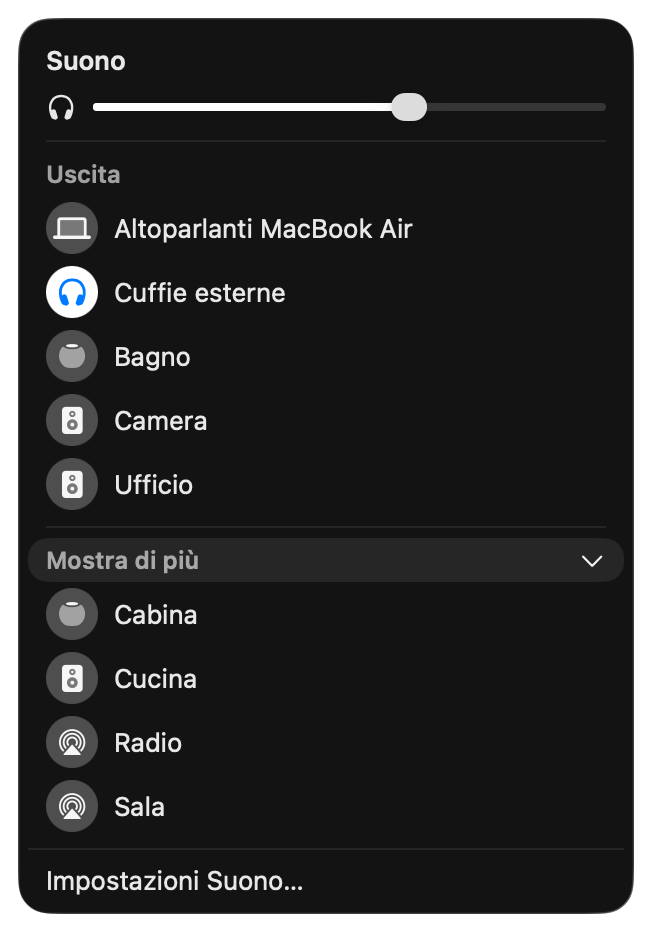
Leaving aside the times when I can’t listen to music in the living room because I haven’t yet used the bazooka on the TV in a world that watches it waiting to die, when my family has better things to do, I can enjoy music to the fullest. In the end, the most obvious solution is simple: I install Volumio 3 on a Raspberry Pi, access the library on the NAS, and listen at least decently.
And I’ve never had any problems doing the same with Sonos speakers either, they access the library, just use the app on your phone. I’m writing this because I fear that my complaints have pushed us in a direction that may not be the best, although over time it could become so, with later versions of ffmpeg, which, however, has never prioritized quality, but speed.
Fusion DSP is one of the best features of Volumio. The issue is the hardware seems to often struggle with it. If you feel an aversion towards DSP because of some ideological purist love towards things being ‘bit-perfect’, something which I do not share, you’re welcome not to use it.
I see you didn’t understand much of what I wrote, it happens and it could be my fault. I have exposed a contradiction between how the product is advertised and what it actually does and in the specific case of my hardware, a Volumio Primo Plus, it is a product that has a real DSP inside the DAC, nothing comparable to what the quad-core Cortex A72 processors can do in real-time, or in 50 ms of latency to be precise, 2.5 times beyond the threshold of perception.
In particular, I complain that with Volumio 4 the “premium” features are not suitable for a product that costs 1,199 euros on the list, I didn’t buy a subwoofer at the supermarket and there’s nothing the plug-in you’re a fan of can do to make my music sound better in another room of my apartment because the moment my lossless tracks are compressed to 128 kbps in AAC with ffmpeg version 5.1.9-0+deb12u1+rpt1, the encoder’s already high latency is added to CamillaDSP’s.
I’m not a bitperfect purist, but I’m savvy enough to know that SoC manufacturers often pay licensing fees to incorporate actual hardware DSPs into their SoCs, something Raspberry Pi doesn’t even provide on its boards.
If you’re an avid listener, you’ll have already realized that the best AAC encoders are those from Apple or Fraunhofer. ffmpeg is one of the worst, so much so that the current version, version 9, has replaced it; it wasn’t even good for movies. Volumio uses version 5.
I gave the example of shaving in the bathroom in the morning and I’m not interested in quality because with the noise of the electric razor a few centimeters from my ears it’s a waste of time. In other situations or to others it might be of interest and to hear badly we didn’t have to buy anything, I already have the DSP present as hardware inside the amplified speakers, starting with Sonos, but I don’t write wonders about it.
I don’t share your opinion either, but I urge you to use your brain. You can’t accuse a generic hardware product that doesn’t even have a built-in DAC (like the Raspberry Pi) of being inadequate because it wasn’t designed for that purpose. The truly inadequate aren’t even those who wasted their time writing software for the missing hardware; in the end, the only fools are those who believe they can get from the von Neumann architecture of PC what the Harvard architecture was created and modified for. Maybe it’s time to realize that even ARM processors need two cycles just to load a constant, but honestly, it’s cheaper to pay for a real DSP.
And I can’t imagine buying a product that boasts high conversion linearity and then using a software equalizer that runs on inadequate hardware. I have a brain; with my product I don’t even adjust the headphone response because there’s no place to plug it in.
I’m sorry, you sound pretty confused to me. Btw, I like to think I’m using my brain quite well and I’m not ‘accusing any generic hardware product’ about anything.
PS. May I suggest you put some effort in putting your thoughts in some order before committing your words to the keyboard and also put some effort in not sounding like a rude person. I’m not at all sure you can do either but it might be worth trying.