@ Wheaton: You think DC, I think AC (and DC at the same time)
I hope you respond your measurements here, i’m very curious about your final power supply because i made a lot of power supplies in the past but never get better than the LT3045 (and parallel for higher current and better specs).
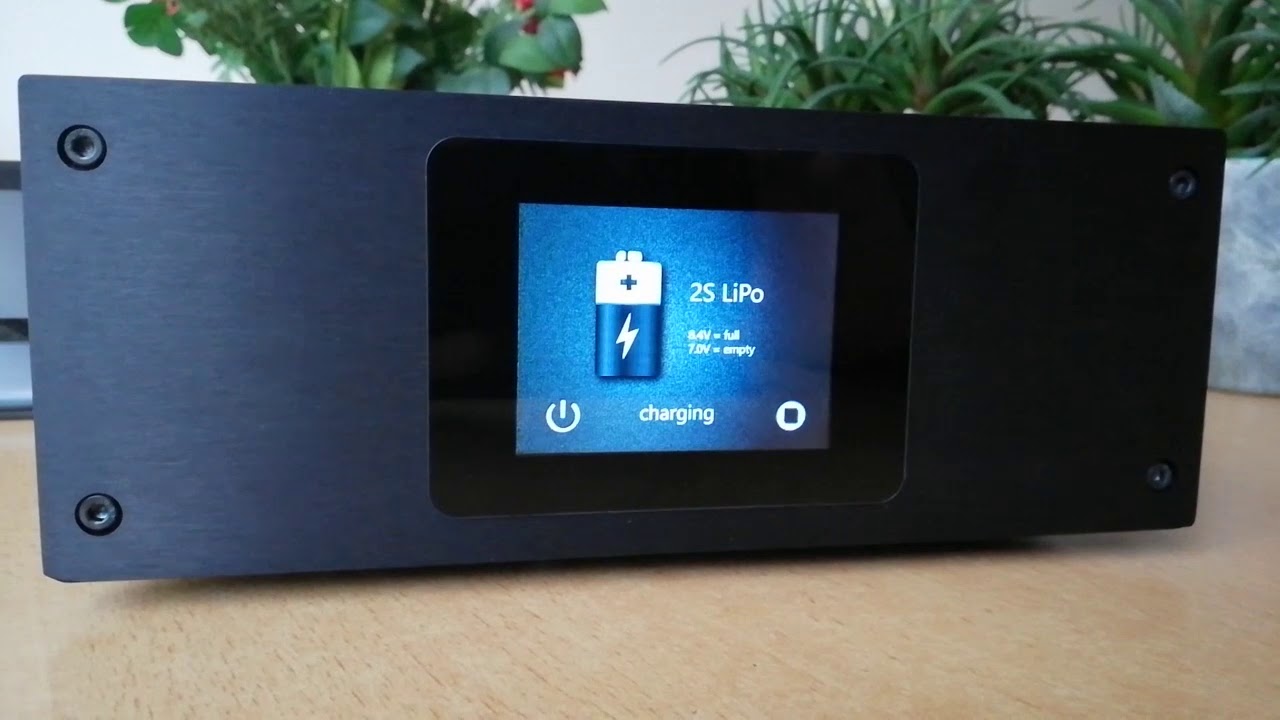
The best i build was a LiPo powered LT3045’s, never measured a better one.
@Kingpin
We will see. At the moment it is just the start.
The PS is now up and running for several hours.
The process of designing is called what I call organic, which means I am now just playing music without too much on quality more how is the sound evolving during break in.
During listening I will get ideas and wait until I know what next step to take.
Indeed only when the design is final I will perhaps post some technical data.
On the other hand I hope you understand that I am NOT chasing specs but I design for optimal sound, and it should also be an elegant design.
By the way I bought in the past 32 pcs 50Ah LiFePo4 cells to find out if that would improve my own designed preamp and power amp.
Well, it didn’t. It sounded lifeless so worse!
I thought you might want to see a photo of the prototype in action…
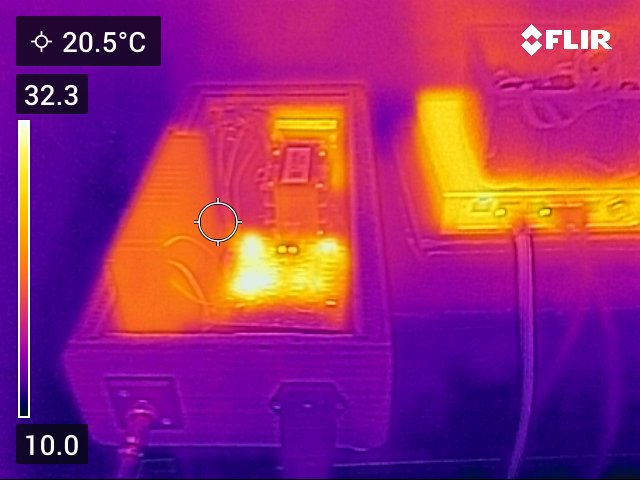
Do you use a Fan in your power supply or is it an heatsink ?
Does your whole streamer have the same temperature as your … what is it … display ?
@Kingpin Passive cooling. Other device is audio ethernet switch. (PS is used for file server/NAS not on the photo
I’ve had the same experience.
In comparison, I preferred the sound of the module with the LT3042 + PNP to the other one with two LT3045s in parallel. I suspect the lower impedance is responsible for the improved sound.
I also noticed the sonic improvement over the first 100 hours and more of use. I’m very happy with it and will stick with the r-Core transformer and LT3042 + PNP configuration.
r-Core Transformator
LHY Audio LT3042 + PNP
It’s important that the power supply for the Raspberry Pi/computer is galvanically isolated from the digital and analog circuits.
In my setup, this is very well implemented using the DigiOne Signature.
That power supply looks a really neat design! I like it.
Also like R core is very nice.
Is the brown elcap an ELMA SILMIC II ?(that would be great, very nice sounding elcap)
In due time nice to experiment with it. Now top priority is to get to my first stable digital setup and live with it for a few months at least.
I just had to do the experiment with the sweet idea for a power supply I got.
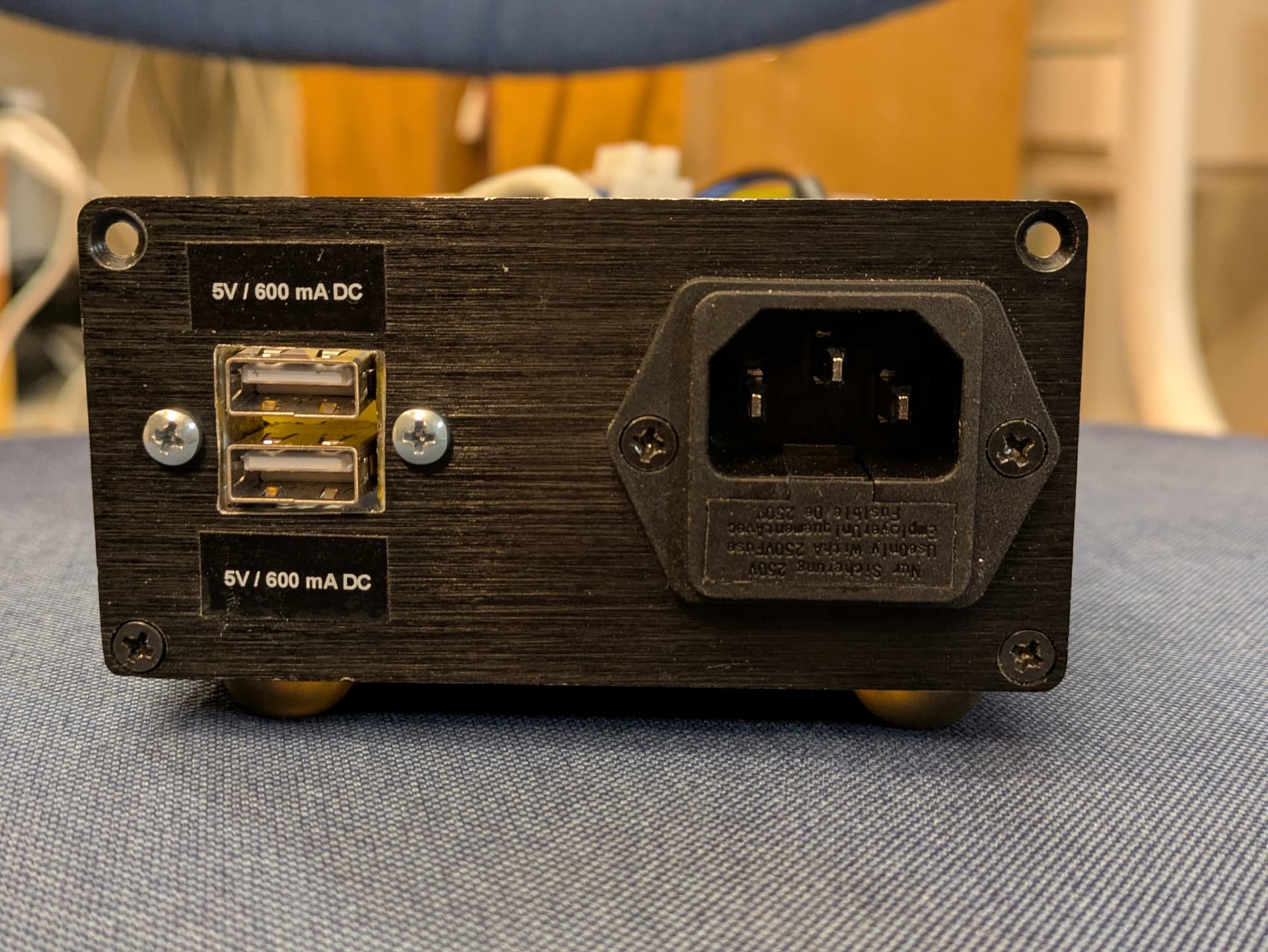
The ROCK 5B uses 3.7 watt during normal operation, 5.7 watt when writing a file to the NMVe and 10W short peak while booting.
I removed the large cooling plate and used a small one: I like the series transistor to get a bit warm.
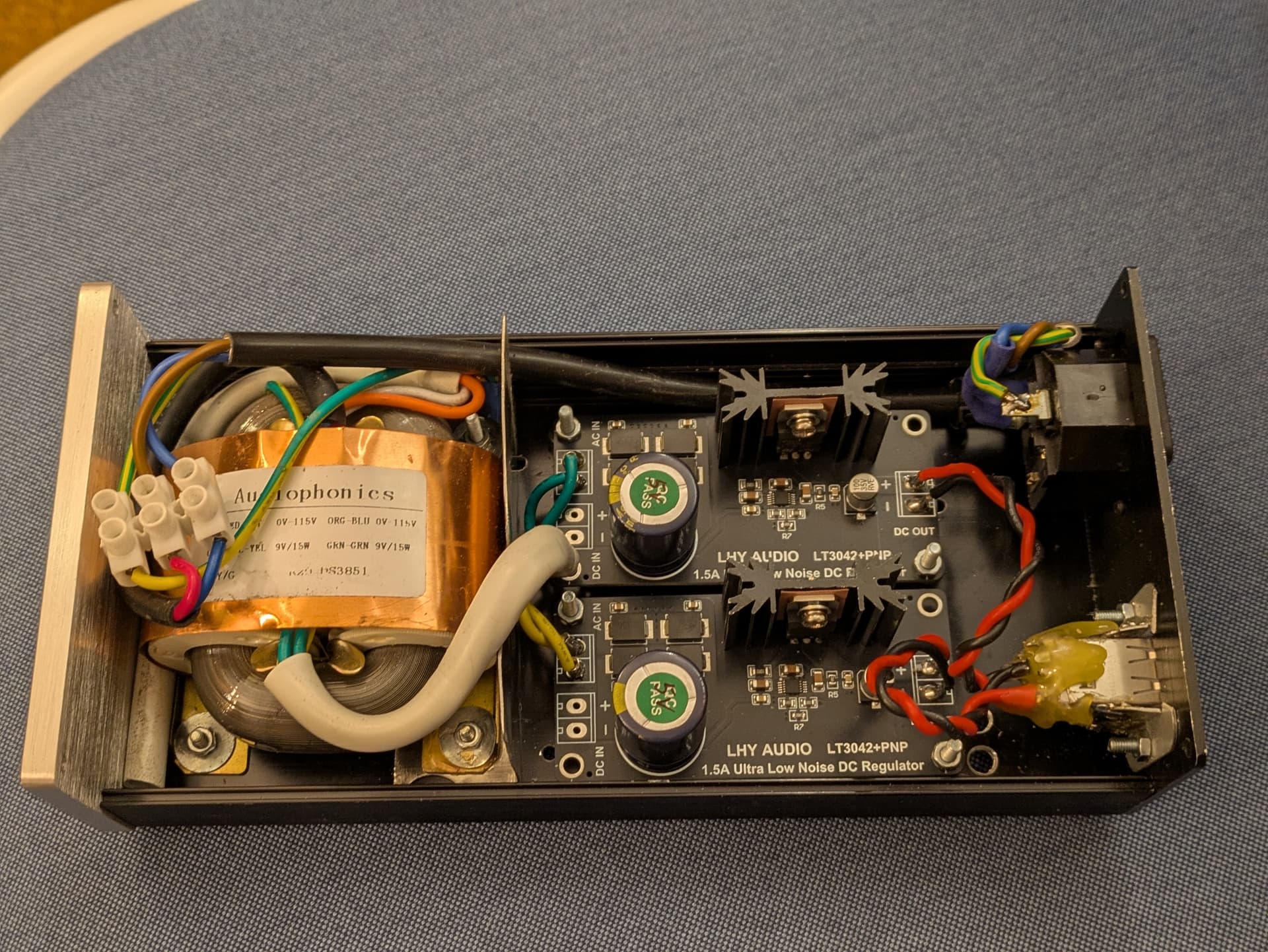
These are Panasonic capacitors, FK series.
The heatsink is a bit small; this can be easily improved with simple means, e.g., a thermal pad attached to the case.
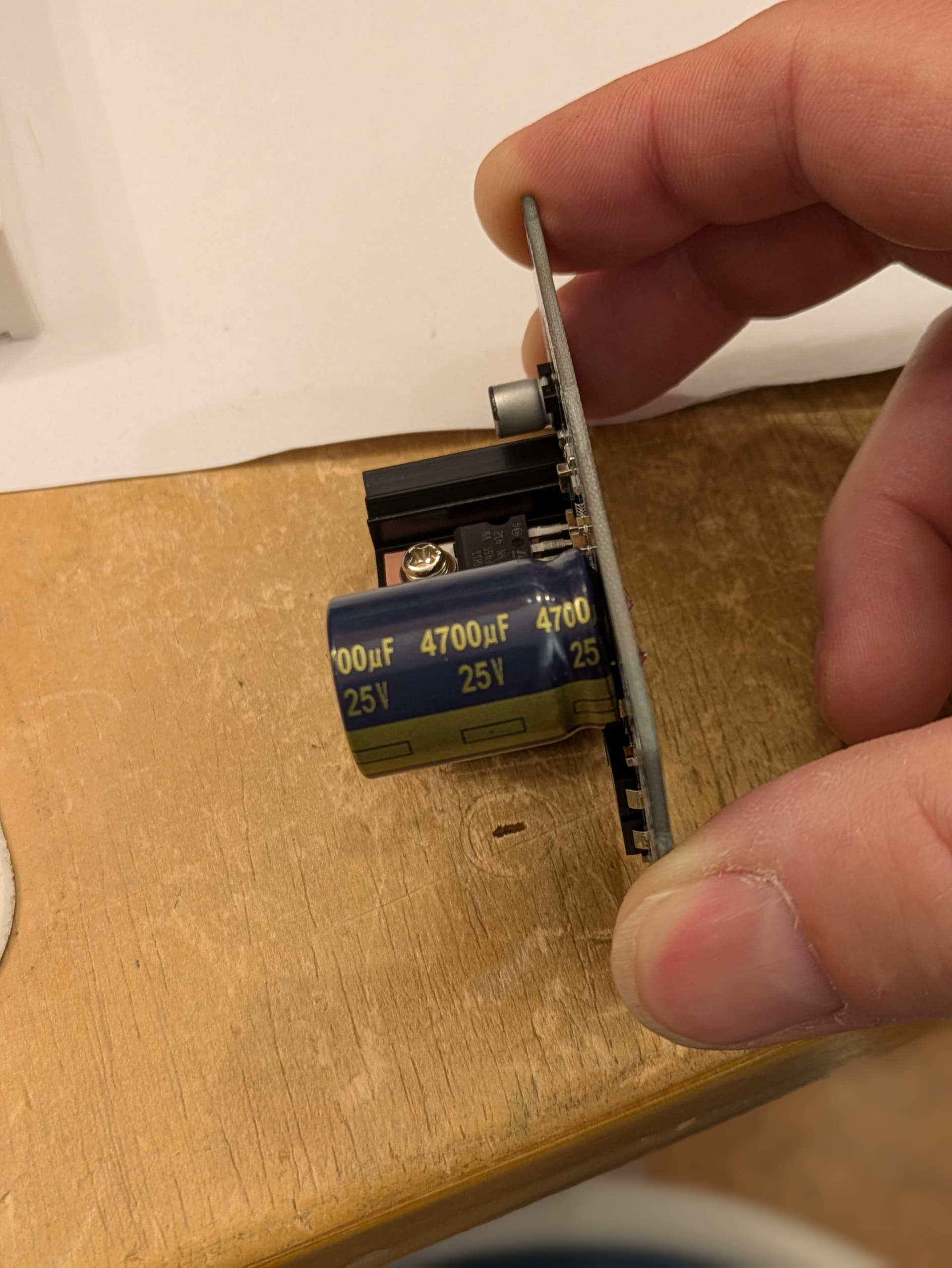
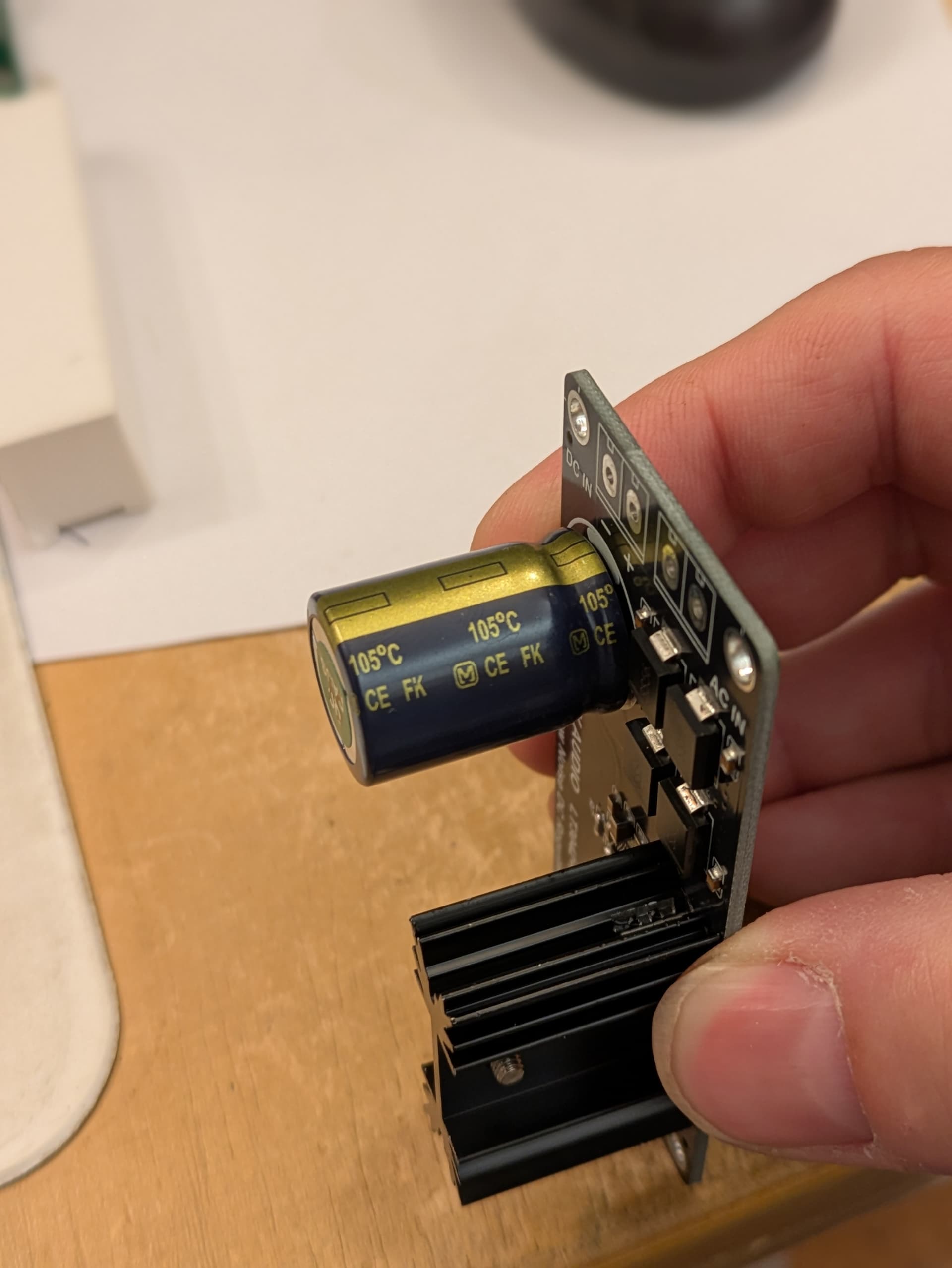
O.K thanks @rost21A rost12A
I am not over the moon with the sound quality yet.
I decided it is time to take the next step an convert it to a 5V supply, which means different transformer, different elcaps, different diodes, different values of the discrete electronics, and adding a second series output transistor.
The latter not really needed, but otherwise the transistor will get in the non linear part of the HFe / IC curve which I don’t like. Perhaps sound-wise experiment with 1 output transistor at some point.
When 5V I can compare with the LINEO 5 and the LHY power supply.
I am still thinking for a way to try a more conventional way of topology, mostly regarding the use of feedback but that would divert from the original idea.
When the LHY sounds better, I think I will just throw in the towel: I have no need for a time consuming design trajectory. Besides that, that isn’t anymore the way I design: the idea has to be so strong and good that it will give quite easy results that are very good.
The ROCK 5B is known to be problematic with power adapters, some not functioning right.
Very long time ago when I did build a power supply for a PS audio Ultralink II DAC I met the problem of startup speed of the power supply that used chokes, messing up the timing of the critical digital startup sequence.
Well, having converted the power supply to 5V I have been met with the same problem. It also uses a (high quality) choke.
I do have some aces in my sleeve, but I haven’t decided if and when to try them.
Nothing being lost: I learned a thing or two in the process and no harm was being done on the digital goodies in the process…
Problem solved: just forgot to swap the choke for one I already had standby for when I would make the conversion for a 18V power supply to a 5V power supply.
So: new developments!
The first idea I had for the topology was ditched when I made the power supply to a lower voltage one. It turned out to be unstable, so prone to oscillation, and there was no viable solution to solve it. The problem was inherent.
So I build an old stable design I had which indeed worked fine.
I found out that I had still problems at 5V to get the ROCK server in it’s right internal startup sequence, but it worked at 6.5V, which meant I still had to use the USB input with the extra on board switching power supply.
I already knew there would be a third version which would benefit from the already existing part of the topology that only served one small, but important role.
I had the idea about immediatly when pondering about it so I did computer simulation, did build it, needed some time to find the right way to make it HF stable, and listened and WOW!
I got the best sound till now it is a game changer.
So some pics from the computer simulation.
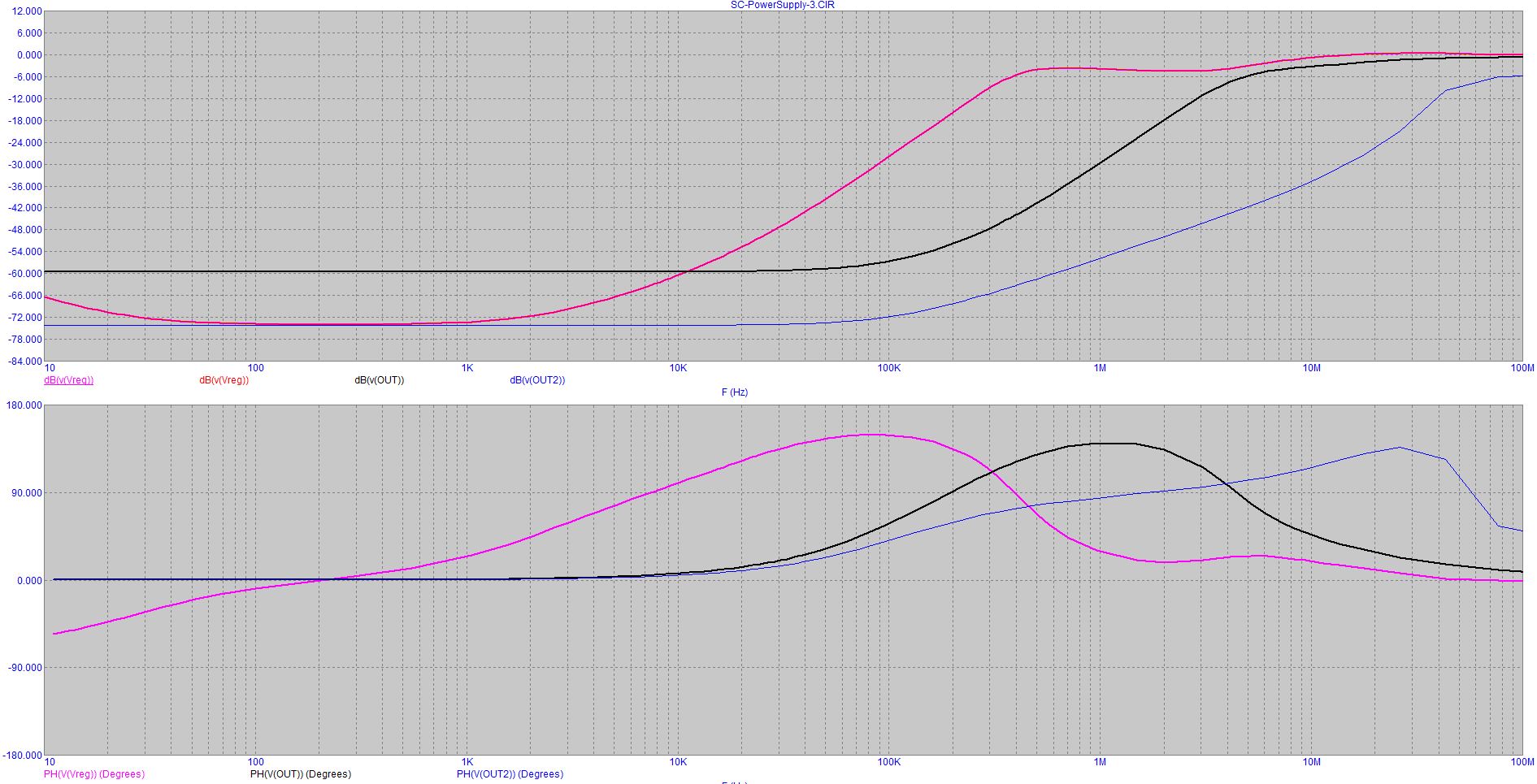
First graph (click on the pic to have a good view and to see how the graphs are paired in two: amplitude and phase) line regulation where I put an sweeping signal source at the input of the power supplies.
Magenta line is a standard LT117: sorry, but the LT317 wasn’t in the library of the simulator.
Black is the pimped up old and proven design.
Blue is the current and definitive topology of the power supply.
So what do we see?
Both black (2nd generation) and Blue have an about flat PSRR til 100KHz, which is exactly what I want.
The LT117 with decoupled reference elcap can about keep up with the 3rd and last gen. PS till 1Khz, then it gets very fast worse.
The 2nd has less PSSR at the start but is linear over the audio band.
And have a look at the phase relation! The LT117 is all over the place, where both the 2nd and 3rd are very flat til 10Khz, and after that still good.
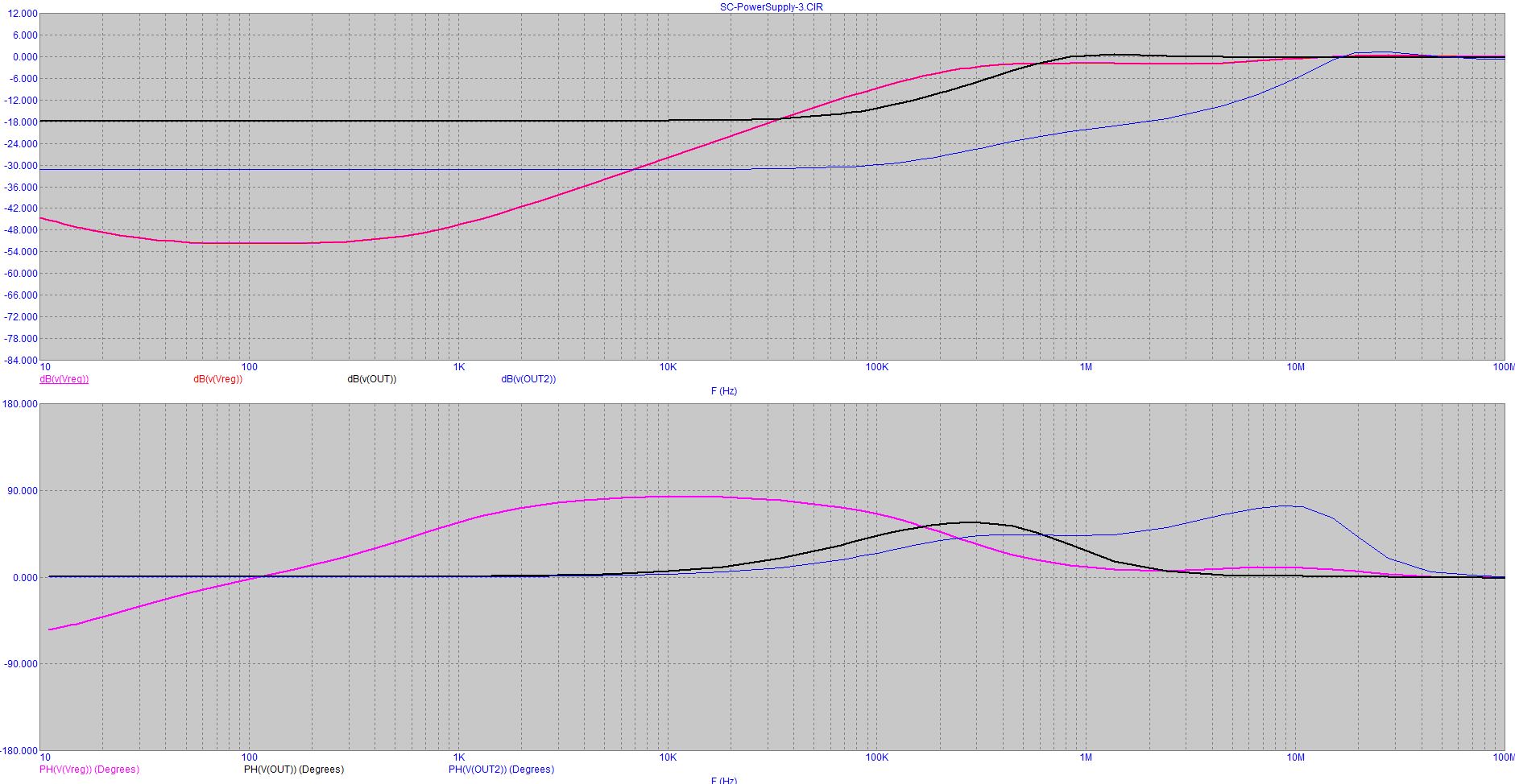
Second pic:
Load regulation. Here I put a signal sweeping source at the output via a 1 Ohm resistor,
The blue being the last gen has for instance a - 32dB which translates to 1 Ohm/40 = 0.025 Ohm
The magenta is again not flat, but at a low band superior to the 2nd and 3rd.
But one has to be realistic: what about the cable that connects to the power input, contact resistance. Linear over the audio band is more important to the sound (is my experience and view) that having a lower impedance at a part of the frequency range.
The 2nd gen has in hindsight an impedance that is too high.
have a look at the graph below depicting the phase behavior: again the LT117 is nothing to write home about and the 2nd and 3rd have stellar phase behavior. Or as we say it over here: is fast as f&ck.
I am really stoked about the sound and the design.
I will do comparison between the LHY pro power supply in subjective listening test versus the 3rd gen. Today I received the second LHY PS to make the comparison.
I had a listen again to the difference between the LINEO 5 and the LHY and it was exactly as the first time I compared: the LHY totally outclasses the LINEO 5. One can hear it immediately as soon as the first tone sets in.
Small addition: I added a current source at the outputs of the power supplies to draw 600 m.a. when doing the simulaton. It is about the value the RIVO+ draws when idle and streaming.
Please note that the graphs don’t tell you all about the purity of the power they supply.
This is a fully discrete design that is very pure. The sense and the nonsense of specs: There are very few people who have a grasp on that.
Good specs are a precursor for the option that something could sound well, is well designed, but it takes much more than that, and is too extensive and complicated to try to convey.
Yeah! Power supply day!
I received a Plixir 5V power supply today for test. Price 1000 Euro.
Of course it wasn’t broken in, so I compared it to a not broken in LHY pro power supply.
Well, the LHY power pro is like a French car that drives supple and you are taken away at the waves of the music, and the Plixir is a German car, where you keep hoping that one day the suspension will soften a bit up, because for the rest it is a awesome car. With the LHY one just enjoy the ride.
So I get drawn in the music with the LHY, and not so with the Plixir, even when it is a very good power supply. The LHY really is a great power supply.
Next test: I tried in the past the LINEO 5 on the small fanless server and found out that using the USB, where it goes through two switching power supplies in a row sounds much better than skipping the first one by using the pins on the PCB board for direct connection.
I supposed it was because the extra power supply masked the flawed sound signature of the LINEO. Boy was I right! I compared both possibilities with the LHY and the difference was relative small, and settled for direct connection to the pins a bit better, it sounded a bit more stable.
After much ABABA etecera with the LHY I used my own design again on the USB power supply connection. I preferred it considerably above the LHY. My design would however cost way more if produced than the LHY, so that is not a fair comparison.
I think the LHY is amazing, a champion, and the LINEO 5 is a shame: the design is fundamentally wrong in my book, and it doesn’t let the potential hear what the RIVO+, which I think is awesome, can do.
And now something else: I received a few days ago the fiber optics to Ethernet converter from LHY.
I tested it between the audio switch from LHY and the RIVO+: it sounded not natural, after switching back to without, the converter at that spot is a 100% clear a no-no.
After that I used the converter to isolate the 29 meter cable from the streamer and used the the isolated ethernet port from the switch that became available, as before it was occupied by said 29 meter cable, for feeding the RIVO+: BINGO! Never sounded better!
The last few days have been a metamorphose sound-wise: It becomes harder, as I prefer just listening to the music, getting involved in it, than working on the sound. Happy days!
I am waiting for NEET silver ethernet cables, and some Tellurium power cords. the silver ones, and two even better ones.
So: to give an overview: the audio switch and the server are near the audio gear, only connection to the quite extended network with managed switches is now optical isolated.
This was the solution I found in the past after two days of deliberating, and as it turned out now that was the right decision.
By the way I could have used more time to see if breaking in the Plixir would solve the problem, but my experience says it will not happen to the extend it needs to do. I mailed the vendor, which will receive this unit back, that if he thinks that I should have taken more time he can send me a broken in unit for test and I will pay for shipment. I could very well be wrong about my feeling about breaking in this unit. (although most likely not, who knows)
So last post. I will close this topic in about a week, so that if anyone wants to comment still can.
Last mile stone: the power supply i designed is now working on 5.2V (like the LINEO 5) and is working on the server were it is connected to some pins on the header thus bypassing the switching power supply on the PCB of the USB power input.
I am stoked with the quality of the sound and just going to enjoy the heck out of playing music.
It started some weeks ago having no idea what streaming exactly was, how it was done, and having no digital in my setup for over 15 years. The reason: it was not good enough yet.
Now ripped CD’s I still had sound better than I ever dreamed they would.
Hurray!
This went al really well. Great success, everybody says so, perhaps the biggest success ever LOL!
O yes, one more thing: For the moment now I regard the server as the music source, so of utmost importance where it comes to sound quality. The cables, including power cords are equally important on server, switch as the streamer and DAC. I think it is wrong to loop upon it otherwise.
I hope some people can benefit for my writings, all the best, good luck.
1 Like
Nice to hear what you achieved and are happy with !
Would be nice to see the output measurements (real) in contrast to the LTSpice measurements
A flat PSRR ~100kHz for an LT317 … hmm.
Keep on the good work.
@Kingpin Thanks.
And no, it is not the LT117 that is flat till 100Khz or the LT317 of course.
DC resistance of my power supply is confirmed by measuring.
I am not bothered to go further is a measuring session.