There is a theory that a cable has to be at least 1 meter, My intuition and brain tells me there is something to that, but never tested it.
Please do yourself a favor and get for example at least the AudioQuest Cinnamon UTP cable or whatever digital interconnect you use. I found out it made a huge improvement for a very reasonable and affordable price. (if you haven’t done so yet and using standard UTP cable)
O.K. major developments.
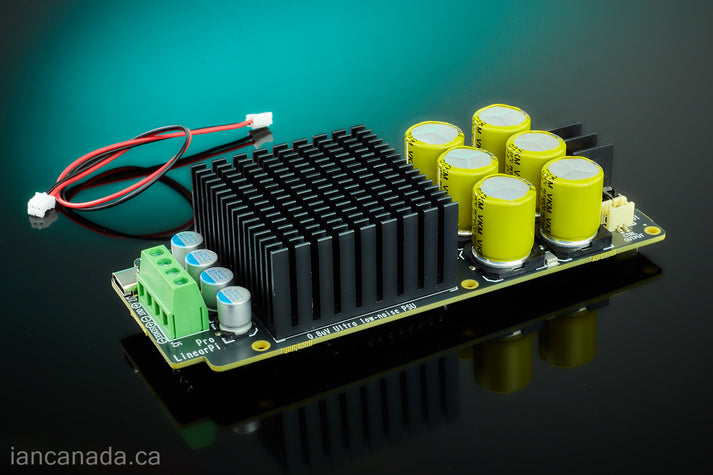
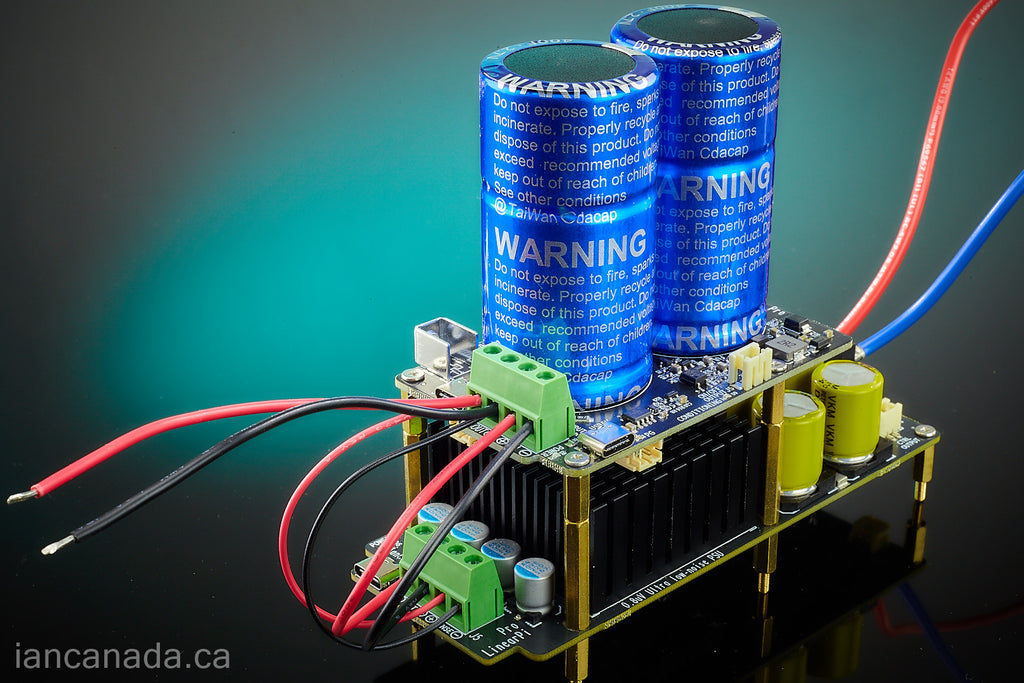
I received a shipment from China of the LHY power supply (the pro), meant for the dedicated server and the 6 port audio switch.
So, I won’t keep strict chronological order.
I already wrote at another post of me something about the design of the LINEO 5.
I tried the new 5V power supply from HY first on the REVO+: well, I am sorry to say, but with the LHY power supply the RIVO+ is lifted to another class: way better, so I kept it in that place.
Both for server as for audio switch a 200-300 EUR power cable doesn’t cut it. My Siltech and Tellurium black were called for. I purchased a second hand AudioQuest NRG Z3: very stiff cord, and in my situation not very good sounding compared to said power cords.
So it is clear: in my very high resolution audio system even the audio switch and server do need absolutely high quality cords: they are very sensitive to that.
I made a power connection direct to the pins of the rock 5 server: this bypasses 1 switching power supply on the PCB. Luckily the Rock 5 is open source and you can get the schenatics for free. The outcome was a true revelation: it transformed the sound to again a much higher quality.
Given my intuition and experience, and still hearing something in the sound that reminds me of the LINEO 5 less stellar performance I ordered an extra LHY pro power supply.
For the first time I recognized streaming from the server the sound of using a CD player in the past, but only better.
Things are coming together. For the first time I feel the sound has come to a real good level.
I will not go further regarding designing and building my own 5V power supplies before this spring and summer. That is something for later.
Sorry again, but I heard the relation to what I found in the design of the LINEO 5 and listening and comparing to the LHY. The LHY breathes more. The large bank of elcaps in the output do kill something of that aspect. I would never ever design a PS that way.
O yes, forgot to say: I ordered connectors for the cords between power supply and device, and made my own very high qualiy pure silver cables. I also replaced the cable to the RIVO plus by a better cable from LHY: that had a clear positive impact on the sound.
O Yes, the audio switch: it sounded better, more details but at first a tad less open en dynamic. During breaking in and all kind of changes, that character has completely vanished.
As said: a high quality power cable is absolutely called for.
I used the isolated input of the switch for the long cable to the router. I skipped the Matrix Audio ethernet isolator: I has no purpose anymore, so I will sell it.
The audio switch has an output for optical cable, so I ordered the LHY optical to ethernet converter.
I just have to test it. You can see at LHY the topology that are possible.
I will test the optical for the long cable and the isolated to RIVO+ and the opposite of that.
An example of my thinking: skipping one switched power supply on the server PCB I heard something of the character of the LINEO5 I thought. Well: the initial extra switching power supply masks to a greater extend that character is my thinking, so that helped to convince me to buy another LHY power supply. Only testing once arrived is the way to establish if that is really the case.
@Kingpin: I wouldn’t know. more // doesn’t mean better for the sound: in general it is the opposite. From the photo I get after googling it I don’t get the idea that the quality is on par with the LHY.
Yes, double devices 1.414 times less noise goes the theory, but an optimal dedicated design wouldn’t have an max output current multiple times what is consumed.
There is are floating a lot flat earth theories around amongst consumers, reviewers and even designers I am afraid. Audio electronics is way more complicated (and once to a large degree understood it gets more easy) than going for large, big and many is a good thing.
@Wheaten: If I had suspected that there was a problem with specs I would have looked into that further. I did have a short look into that.
The value of specs go only so far. Measuring is only one tool in the box of designing. Audio design is way more complicated than striving for good specs. Most people don’t have a clue about that.
@Kingpin Yes, the LM 317 has been around as long as I remember, 40 years or so? That LT3045 seems interesting to me. I have to dive into ithat at some time.
I am using a Zerozone power supply with R-core transformer . https://nl.aliexpress.com/item/32930997184.html
It is fast and airy. Very clean sound, inner tonality improved over the 01a I was previously using. In a transparent system it could even be too much.
A lot of nice suggestions for a power supply: there is a lot fun to be had for relative little money.
In the mean time I am asking myself if everything falls in place once I get the new 5V LHY power supply, or will I get lost in the woods?
I reverted to using the USB input of the ROCK5, meaning that the extra on board switching power supply is active once again. This masks a bit it my thinking the sound of the LINEO5.
The point is that is sounds awesome without the extra switching on board power supply, loads of good stuff, but I keep thinking “this sounds really well” but I am not just drawn into the music.
This is a big red flag.
I guess at the end there is also a thing called “taste” In my case I would say that is should sound effortless, dynamic, as a unity for top to bottom, transparent, detailed, organic, with authority, thunderous and relaxing involving at the same time. My analog system has all these realized.
Where the “one less switching power supply” setup falls short is in the involving, thunderous and relaxing department.
The initial thought was to have just a very nice sounding digital setup besides my superb analog setup.
Impressed by the results thus far I am thinking now that it could be a worthy second reference, different than analog but a worthy companion.
This sets the bar very high: I hope that won’t turn out to be too problematic.
As this is a zero to a full digital streaming solution my goal was, and still is, to get asap to a solution where I can live with for longer (meaning there are no obvious shortcomings) and where I don’t go to a granular level: just factory standard solutions (save for the server) with just some added devices in between the mains to the digital devices where needed.
This first phase should establish and solve the total setup, the and the optimal cabling, and give much insight into what matters and what defines sound quality.
Much of this has already been realized: so is it for instance clear that I do have to use the same high quality power cables as in the rest of the analog gear, as it seems to have the same impact on sound as on the analog gear. Remarkable insight already to my view.
So… I have been thinking loosely last days about the problems of designing a low voltage (5V) relative high current power supply: what topology?
Yesterday while listening and in ZEN mode THE solution came to me: a design that ticks all boxes, where everything seem to fit like a puzzle, fully discrete. (that is no IC’s used)
The design is totally specific for it’s application and unlike everything else that exists.
It is designed with the idea of what is important, and with what I can get away, so is not important.
So it will inferior in some ways and superior in some ways to existing designs.
It remains to be seen how this is going to work out: I trust the design, but only real world test will show the quality or the lack thereof.
The PS (power supply) at the moment only exists in my head and is quite bonkers, but elegant I think.
First step where that can already derail the design is computer simulation.
So you can follow me along to failure or success.
@Kingpin
I will use it first for the file server. A rock5.
Initially because it is more simple for the USB power input as it has a large voltage range so I can choose first a higher voltage with of course lower current.
Main effort will be on “open sounding” and line regulation (PSRR)
Load regulation will be secondary.
Both line en load regulation will be linear over a very wide bandwidth, think 0 Hz to 100 Khz, so totally different form a classic design.
At a later point 5V direct to the pins of the ROCK5 server, eliminating a switching power supply, and if all is stable for the RIVO+
The main point is to find out if some specs that are generally are considered important in a good power supply are not that important at all. Sheer power delivery many amps (multiple time what is needed) is for instance that is deemed oh so important but BS.
Chasing the wrong specs and/or beyond reasonable, leads to sub optimal designs is my stance.