Analog high-end developer dipping his toe in digital

I have an ultra resolving audio system, everybody says so. Perhaps the best in the world.
I like it, I like it a lot!

Anyway: a bit of history.
I have been developing high-end analog audio for a few decades,
A discrete transistor preamp with MC phono in and line stage (3rd generation) and at this point a hybrid power amp and a 3 phase motor drive for my SME30A turntable.

I made two attempts with digital: first one a PS audio Ultralink II and a Lambda CD drive.
Later a full DcS stack with Esoteric X3 as a CD/SACD drive.

Both times after using them for a short time they disappeared into a closet, wasn’t interested to listen to it permanently, sold everything and swore to never again invest in digital.

So I didn’t kept my promise and bought a Gustard R30 DAC and the RIVO+ with it’s analog power supply. I added the Matrix SI-1 ethernet isolator.

At the end I had to build for all three devices to put in the mains to prevent common mode currents, and that elevated the sound a lot.

My experience: digital has come a long way, and it seems from studying the market, that they finally start to understand some things about digital design.
After 2 weeks of intensive testing, listening and even enjoying the sound I put on a record again: well, first thing to say that I have no regret whatsoever investing and starting to listen again to digital, but the analog beets the snot out of the digital right now. Just the number that gets into my mind immediately: analog sounds 10 times better. Way more transparent, and just sounding right.

Well, this is the first part. I will write a part about my ethernet network with smart switches and how I got the idea to leave that in tact but optimize the network for streaming from the internet and from a home file server.

1 Like

I just a couple months ago I did find out that my ethernet network existed with cat5 cable.
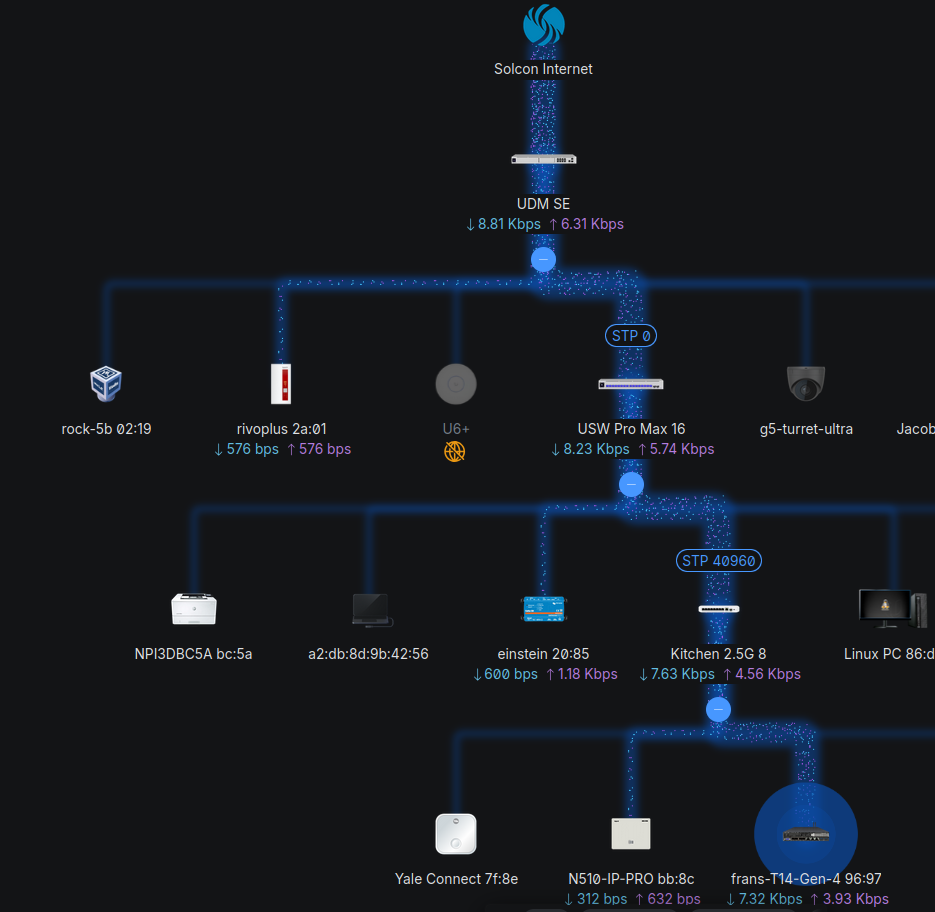
Ouch! I decided to replace everything with cat 6a, about 150 meters or 450 feet, and also bought Unify managed switches: 3 pcs 8 port, 2.5 Gb/s and a 16 port 1Gb/s an a UDM SE pro, the latter being the router that goes to 1Gb/s glasfiber internet connection.
Somewhere in the network an Intel NUC linux server that has a volume that is used for streaming to the RIVO+

After thinking how to optimize the streaming with the given network I couldn’t at first find a solution till I suddenly got the right idea.

We need a new dedicated file server, low power, analog power supply, and a audio switch and dedicated laptop.
The switch connects direct to the UDM SE pro on it;s own subnet.
The dedicated laptop, the file server and the Rivo+ (with ethernet isolator in between) are the connections to the audio switch.

So I ordered a AS6 | Audiophile Network Switch and a LPS-50 Pro | Pro Series 50W Audio-Grade Ultra-Low Noise Linear Power Supply from LHY.

I studied two days on what to use as a file server.
First I was thinking of a Raspberry 5, but that didn’t seem ideal.
What was I looking for?
A small low power computer, passive cooling, looking a bit professional, no blue tooth, no WIFI, and having a slot for a NVMe storage card.
In the end the solution is a bit overkill, but a bit of speed never hurts.
I ordered the following at RS components: from RADXA (RS components call it “OKDO”) the rock 5B, eMMC module 32G, eMMC reader, 5B metal case and the 36W PD + QC Multihead PSU.

The PSU (power supply) is cheap, and just to start installing everything, it will be replaced by a linear power supply.

For the file server I will use the (linux) Debian file from RADXA to install, and add NFS server capability. Should be not too difficult. Oh, and yes I ordered a 2 TB NMVe for storing the audio files

I will chime in later when everything is up and running.

1 Like

So a few observations after a few weeks of digital.

First of all I used Qobuz for streaming direct and buying records.
Streaming via the internet sounds different, less, than streaming from my file server.

Secondly: the quality of the recordings, and also the conversion to digital differs hugely.
I do have a reference of course of vinyl and know what quality is possible.
I had several times when I was looking at the display of my DAC to see that indeed I was listening to 44.1 Khz. Some recordings sound really well in 44.1 to my amazement.

I tried of course also 96 Khz and 192 Khz, and till now my observation is that the bass and authority seems to suffer at higher sampling rates.

I also tried DSD dowloaded to my server.
DSD direct to my Gustard R30 and using the conversion to PCM sounded really the most natural and the best. Direct DSD (the GUSTARD offers that option) seemed more powerful sound but not natural. I couldn’t stand listening to it.
The direct DSD to PCM sounded perhaps the best form everything I listened to.

By the way: all digital (and analog) components are isolated from vibration and all Siltech power cords. AudioQuest Dragon 48 HDMI cable from RIVO+ to Gustard. Hardwired ethernet cable from the Matrix Audio SI-1 ethernet isolator to the RIVO+

1 Like

Hi Frans,

thanks for your interesting report! I am listening to both analog and digital since many years (although not at the level of your gear), therefore, I am always very interested in comparisons. I often found digital more “tiring” after a while, even in cases when I couldn’t put my finger on obvious differences. This is confirmed by several of my audiophile friends.

Now, as you doubtlessly are aware of, nearly all vinyl releases in the past decades went through some digital stage during production. What do you make of those? Or are you always listening to genuine AAA recordings? I guess the question I am asking is this: Can intermediate digital processing with state-of.art studio equipment lead, in your opinion, to acceptable results in a vinyl product?

In any case, happy listening & Kind Regards

– Reiner

All, keep in mind that it’s almost impossible to compare vinyl vs digital.
You should choose the sound that is best to your liking.

  • Most of the masters used for vinyl, are different then those used for digital processing. So if you want an A to A comparison you should listen to an identical master used for vinyl, converted to / published as digital
  • Every vinyl track has been touched by sound engineers, bass to mono < 150Hz (to avoid the arm jumping off the vinyl), Reduced dynamics etc. as the tracks need to fit the physical medium. the majority of people like these changes, where the digital tracks are not altered.
  • Vinyl wins on vibes. The big sleeve, Physical interaction
1 Like

Another way to compare A and D is to convert A playback to high-res D.

I agree completely that comparing releases produced from different masters is meaningless.

And, yes, A doesn’t mean the sound has not been manipulated. As you point out, there are many ways to do so.

Hi haehnie and Wheaten,

Thank you for your very good and not emotional input.

I am brushing with broad strokes and not trying to prove anything, I just tell it as I see it, I might be completely wrong. (though I am not, every body says so hehe!)

What I am tried to say is that this 3rd time I can really enjoy digital and I have the feeling that it will be just another way that I will enjoy music in the future.

About all analog in the recording chain versus a recording where there have been used digital equipment I do have a story.
A friend of my gave me about 2 foot of vinyl records. I did trow away immediately about 90%
The rest went first trough a wet cleaning sequence and was played, and thrown away anyway most of the time.
There was a recording not to my taste: fiom an old Dutch (renown) dixieland band.
I hesitated if I should throw it away or try. So I tried it, it was a recording from 1959.
I was gobsmacked!! WHAT THE HECK DID WE DO all those 50 years???
Subjectively it was in the top 2 of my best sounding records.

I have some records that ooze analog quality, which is really a quality easily identified and enjoyed, I have records that ooze digital, still enjoyable for the good musical content.
There are some types of music where a more digital sound seem not to harm the experience or even (seldom) enhance the listening experience.

There is so much that can go wrong, so much that at the end makes of the total quality of sound that one have to be nuanced.
Also saying that there is only 1 thing important: how much you enjoy listening, be it to digital or analog.

So yesterday I listend streaming in 44.1 Khz music I do have on vinyl.
There was 1 case where I enjoyed the heck out of it because it had some qualities that were much better than the vinyl (the mid range being very resolving, and spatial). Then I had 3 albums in a row where I stopped about immediately because they were sounding flat as a pancake, I couldn’t enjoy it at all, the vinyl sound way better.

In almost every digital I stream I do hear shortcomings, every time different and and a huge spread of quality. Sometimes it seems flawless, sounding as a unity, not having some aberrations that distracts from enjoying the music.

I Should say however that my analog chain is multiple times more expensive than the digital chain.
My cartridge is out of this world good. Second to none. I had a comparison with a 12.000 EUR cartridge and it totally destroyed it.

1 Like

Something about dynamics of vinyl.

I had once a speaker builder visiting me to demonstrate his speakers.
Once he saw that I had no CD player he disappointingly said that vinyl lacks dynamics.
So: he sat at the listening chair and I thought: wait a minute. (Yes, i said that to myself: wait a minute, I really did!)

So I put a record on that starts with a incredible big explosion of sound.
I do not kid you, honestly: the man literally almost fell from his chair!

Vinyl can sound dynamic and explosive like you wouldn’t believe, but it takes a very, very good analog reproduction chain. A 1000 EUR turntable won’t cut the cake.

Oh, and yes, it is not on all fronts that analog seems to be better than digital. There are some aspects where digital seems better than analog.
Two different beast where both can sound mighty impressive and enjoyable.
(which wasn’t the case let’s say some 10 years ago to my perception)

So, the Rock 5B form radxa arrived today, and It is up and running as NFS file server for the RIVO+.
It is now near the audio equipment, instead of 10s of meters ethernet cable away.
For the time being I used an old 1Gb Netgear 5 port switch, still waiting for the audio switch to arrive.
I must say I am very impressed. While configuring the server it got warm, not hot, but now as server the passive cooled Rock 5B gets barely luke warm. I think it consumes 2W or so.
It is still on it’s small switching power. I will use, when it arrives a kinear 5V power supply that has to be connected direct to some pins of the header. Now it is on the USB C input, which is auto negating and as I assume switching it down to 5V, so in the future there will be 2 switching PS less.

Also very impressed by the gains in sound quality!

Another thing: today two AudioQuest cinnemon ethernet cables arrived, 0.75 meter and 3 meter.
Well, the replaced just above standard ethernet cable quality.
I couldn’t believe my ears! They made a HUGE impact, improvement on the sound: stunning!

I also order 35 meter AudioQuest forest cable with 2 telegarter UTP connectors.
Change of plan: I will skip a dedicated laptop for streaming. One device less on the audio switch, and the audio switch will be connected with said 35 meter cable directly to my UDM SE PRO router.

The advice I got on the phone with the AudioQuest dealer and which makes much sense and I fully trust is that is better not to mix different kinds of ethernet cables, and that down and upstream in the chain is about even important.

I am very happy with the new file server: it did cost some bucks, but it will do it’s work for many, many years to come, and the power consumption is about nothing. Awesome!

1 Like

Hi Frans,

Why you use a NUC instead of an SSD directly to the Rivo+ ?

Hi @Kingpin:

reasons: 1: I can’t reach it then over the network (I suppose) 2: A USB stick direct on the RIVO+ sounded not good at all
it is not a NUC, it is much more compact, and has passive cooling,
The speed of transfer over the network when I migrated the files was about 500Mb/sec. That is doable, fast enough.

By the way: I listened till deep in the night: the sound has transformed. Still there are more serious upgrades to come. I really enjoy digital right now. I had to wait a freaking 40 years before digital became somthing I can listen to. Damn!

An SSD on the USB input can be reached over the network without any problems.
I did also some serious testings between my NAS (cabled, wifi) and USB inputs.
My Rivo+ is connected through I2S to my Gustard DAC.
I deliberately selected the SSD based on the chip with the lowest noise floor.
There is no difference between my NAS/wifi and SSD on USB input (lucky me).
And yes my system is very resolving.
I also think that the DAC is most responsible for this.
Keep up the good work, nice to see you are building things which improve the sound to your likings.

@Kingpin So you can write and delete to the SSD from a computer on the network?

Yes.

@Kingpin That is a good solution then. If it sounds right all the better!

better late than never! :sunglasses:

1 Like

So In installed 29 meter AudioQuest forest UTP cable from the switch at my stereo to the router.
Sounded awful in the begin. I managed to listen without analyzing but of course noticing the spades of midrange glare. brrrr…
Anyway: it sounds now very good, nothing bad that stands out.

Today I did a kind of tests and experiments, for instance removing the ethernet cable from router to the stereo to listen to the difference. Once the RIVO+ gets the instructions from a computer on the network in a web browser page, it keeps on playing.

At the end I removed the Matrix Audio ethernet isolator that feeds the RIVO+ and placed it between the long run cable from the router to stereo and the switch. Both removing and placing elsewhere showed better sound.

Oh, and yes: streaming from the internet (Qobuz) sounds remarkably good. Better that I remember it ever did. The 29 meter AudioQuest cable and Matrix Audio ethernet isolator and the direct connection to the router instead of somwhere else in the network? Probably.

@haehnle
I think a ladder DAC also a R2R DAC called has a better chance to sound non fatiguing, but don’t take my word for it only .
I choose based on YT listening to sound and from what the general consensus is about the sound of the different types of DAC deliberately for a ladder DAC.

My DAC is a Heed Obelisk DA and I am quite happy with it. With good sources it sounds fine and I can listen without getting tired. All my digital cables are quite short (at most 1 m) and I have decent Cardas cables for power supply (this makes an audible difference). Transport is by a Rivo with good external power supply (very notable difference). I look much forward to having Volumio 4 on the Rivo.