Exactly. Reinstallation succeded and now it works. Problems with DSD256 and some other HR files.
Guten Tag
Ich bin normaler Home User (ohne Rasp. Kentnisse)
=> Wie upgrade ich meinen Rivo+ von 3.912 auf 4.119 ?
Danke im Voraus
Peter
Please only write in English, there are plenty of tools availble.
Don’t assume that people visiting this forum, will do the translation for you. Thanks.
Please read the first post of this topic, so you know the roll-out plan for Volumio Hardware.
(Rivo+ is planned for the end of June)
Es ist noch früh, ich habe es noch nicht oben im Thread mit einem Veröffentlichungsdatum gesehen, also habt Geduld.
Don’t pay attention to them, they’re Italians, or worse, Florentines who can’t even write decently in Dante’s language, their own. They don’t understand that to have the ambition to sell you a product like the Rivo Plus for €1,199, they have to give you something that’s rewarding in every way, including their language skills.
The interface of Volumio in Italian, for example, seems to have been written by children who need to repeat primary school, unfortunately they did not fail them.
Me too, asked in the past to use my own language, but then I wondered if it was really appropriate with people who don’t even speak their own, and I changed my mind. We’re lucky this way, believe me.
Let’s keep this a bit more grounded. The Volumio forum is not run by a paid support team or a team of professional translators, it’s maintained by volunteers in their free time. People who help because they want to, not because they’re getting a salary or a language diploma for it.
To make sure enough people can follow the conversation and contribute, we request to only use English on the forum. That’s the price of a community-driven platform, and honestly, it’s a pretty fair deal considering it’s all done out of goodwill.
So maybe let’s aim the criticism a bit lower on the drama scale and a bit higher on appreciation.
2 Likes
I don’t mean to make gratuitous criticisms; on the contrary, it was vitriolic, but it was a surrender  Here in this discussion, you have customers who have purchased your products, as in my case, also to enable the company to grow.
There are aspects of the Volumio interface that need to be revised, sometimes for accessibility, other times for consent to data processing, other times because the translation needs improvement. There are reiterations of the same words, too many, and even those don’t follow any rule, and you find the same labels on the buttons, even written differently from the titles or descriptions. This is a lack of method, as well as style. The sooner you identify the problems, the sooner you start addressing them. I’ll give you an example: Apple sells between 60 and 70 million iPhones per quarter. Search their forums (in English) to see how many people are asking how to update their phone. They’ve done a good job before.
Then there are questions of opportunity, one such example being whether it’s appropriate to serve paying customers last, especially when they pay for features that involve interoperability between multiple devices on the same network and end up with non-aligned versions—3 and 4, for example.
There’s also the opposite problem, where you fix a bug that prevented Volumio from booting on Raspberry Pi 3s, and a month goes by without anything happening publicly—that is, without disclosing to those asking on the forum that the solution is to put a # in front of a line in a file in /boot. But when we don’t spend, we’re all more tolerant.
Sometimes, there seems to be a lack of consideration for the context in which you operate. For example, for months, it was difficult to find the Raspberry Pi that some free users wanted, so they bought the ones that were available. I even happened to buy one of your products that wasn’t available, but in this case, I realize I’ve found impeccable sales management.
In my opinion, an effort should be made to use LTS kernels, always the latest available, and perhaps rely less on Armbian and more on Raspberry Pi to decide when it’s time to update the operating system.
Going back in the discussion I pointed out to you:
avahi-daemon/now 0.8-10+deb12u1 armhf [installed,local]
If I look at the component that prevented me from finding the web interface at the previous URL on the first reboot, I find that avahi-daemon is for armhf, while if I look at the operating system I find that:
Welcome to Volumio for CM4 (6.12.75-v8+ aarch64)
Welcome to Volumio for Raspberry Pi (6.12.75-v7+ armv7l)
Welcome to Volumio for Raspberry Pi (6.12.74-v7+ armv7l)
When Raspberry Pi reports for the Zero model:
Linux rpi-zero 6.18.33+rpt-rpi-v6 #1 Raspbian 1:6.18.33-1+rpt1 (2026-06-01) armv6l GNU/Linux
Why are you shipping me an aarch64 OS with avahi-daemon for armhf?
Does this make sense when the system runs only on aarch64?
Finally, I’m also happy to play guinea pig with a Raspberry Pi before discovering problems with the Primo Plus or any other model, but frankly we can’t do that when there’s no distribution that resembles the other at least in fundamentals.
Having fewer ISAs would be helpful, so why not try reducing them to two without hybridizing them? Aren’t today AMD64 and aarch64 enough for everything?
Hey @Celona,
This thread is for the Bookworm rollout across Volumio hardware garage. At any point - these responses are off-topic.
Let me address the avahi-daemon armhf point directly, because it is the one technical assertion in your post that has a clean factual answer, and it is a misreading of how the platform is built.
The architecture facts:
-
ARMv8-A defines two execution states: AArch64 (the A64 instruction set) and AArch32 (the A32/T32 instruction sets). AArch32 at EL0 exists specifically to provide user-space compatibility with ARMv7-A. See ARM’s own architecture definition: a 64-bit kernel can run 32-bit applications, but a 64-bit user space requires a 64-bit kernel.
-
This means a 64-bit kernel (aarch64) over a 32-bit user land (armhf) is not a contradiction. It is a documented, supported configuration: AArch64 kernel, AArch32_EL0 user space. The Raspberry Pi kernel parameter arm_64bit=0 toggles between the v7 and v8 kernel exactly because both are expected to sit over the same armhf user land.
So the banner line and the package architecture are reporting two different layers:
- “Welcome to Volumio for CM4 (6.12.75-v8+ aarch64)” - this is uname reporting the KERNEL. v8+, aarch64. Correct.
- “avahi-daemon/now 0.8-10+deb12u1 armhf [installed,local]” - this is dpkg reporting a USER-SPACE package. armhf. Also correct.
There is no mismatch. The kernel is 64-bit; the Debian Bookworm user land is 32-bit armhf. avahi-daemon is a user-space binary, so it is armhf by design, not by accident. Your question “why ship an aarch64 OS with avahi-daemon for armhf” rests on the premise that the OS is aarch64 end to end. It is not. The kernel is aarch64, the user land is armhf. That is the entire platform model, and it is deliberate.
Why this model is used: keeping a single armhf user land across the Pi range means one set of user-space binaries and plugins runs on every supported board, while each board still gets the kernel best suited to it (v6, v7, v7l, v8). Splitting user land per board would multiply the build and plugin matrix without functional gain for the user.
On the rest:
The Pi Zero (armv6l) point is a separate matter. armv6l cannot run the armhf (ARMv7 hard-float EABI) user land at all - it is a different ABI baseline, not a kernel toggle. The decision to drop Pi Zero support was communicated, and it is driven by upstream: several key dependency libraries no longer ship for armv6l. That is not a Volumio choice so much as a consequence of the wider ecosystem moving on.
The Raspberry Pi OS comparison does not hold either, for the same architectural reason above. Your rpi-zero line shows a v6l kernel with an armhf-derived user land on a different SoC class. That is a different kernel, a different ABI floor, and a different distribution policy. Comparing its uname string to a CM4 banner is comparing two different layers across two different platforms.
The interface, translation, consent, and release-cadence points you raise are real product concerns, but they are not technical defects and they are not mine to adjudicate here. They belong with the project leads, not in a thread where the underlying claim was an architecture misread.
Kind Regards,
Thanks, Nerd, the reason I mentioned the Raspberry Pi Zero was simply to show that even their oldest product that you can buy uses the latest Long Term Support (LTS) kernel. Volumio is based on Bookworm, not Trixie, but using the latest LTS kernel theoretically allows you to focus on other things for a longer period of time.
Let’s get the Italian language issue out of the way. I was trying to be funny, because seriously, I would have written worse. In your shoes, I’d also address these issues last because the reality is that we adapt. The problem is that the entry-level price isn’t enough for a user to accept less than a job well done. You understand, I wouldn’t raise the same criticism for the free version.
While in other discussions I’m a free user who accepts the product as provided, in this one I feel like a user who has purchased a good, and my attitude is different, and rightly so.
When I post in a customer thread, I don’t want to become a Garage forum participant; I want to enjoy music without distractions or other worries; that’s what I paid for.
The fact that I have to worry about the IP address of the Volumio interface when I reboot isn’t a problem for me, but it might be for other “consumers.” I have a positive opinion of your work; I like Volumio, and I wish the new versions had fewer problems than previous ones; more, I wish they were even better.
What happens when you choose to stick with older versions of the kernel and the GNU operating system is that fixes already made for other purposes are implicitly missing. For example, the latest LTS kernel (not the one Armbian runs its questionable tests on) fixes memory corruption issues, and perhaps the latest avahi-daemon (which isn’t the one currently in use) would prevent your customers from not finding the interface after an update. I just tried to explain, and with a different software version for every device I have at home, I really don’t think I can.
I’ve never found a service like the one Nerd provides to everyone; that’s not what I’m talking about. To keep Volumio relevant (which is in my financial interest, otherwise I’d have wasted my money), you need to prevent paid features from being unavailable (or malfunctioning) due to software mismatches between your products.
Otherwise, you’ll have hybrid users, who pay for a service and also use the free version, who ultimately find no satisfaction in having spent money on your hardware. And the same people exhibit different attitudes when participating in projects they love and when they pay.
I’ll refrain from asking why the Raspberry Pi operating system is entirely aarch64; it’s obviously not a problem for them. It’s not a matter of choice. If you pretend that ffmpeg 5 is fine, even in armhf (whose discontinuation is well known; elsewhere, version 8 is used), you won’t find anyone, inside or outside your company, who cares about improving it.
As a result, your users will be cut off from listening to some web radio stations—I read correctly—because of your choices that others don’t make. This is because the MPEG-D USAC decoder is missing (standardized by ISO in 2012 and even available on Windows 11 and Raspberry Pi, as well as a format used in India, Brazil, etc.). They will hear music and radio at different volumes because the old ffmpeg doesn’t follow the current rules for normalization to -23 LUFS, etc.
A new version could also open up new possibilities, e.g. That’s the option of continuing to listen with Bluetooth headphones if you have to take a dump in the bathroom or if you have a large family that wants to watch TV where you’ve placed your stereo.
An update should also bring new capabilities; I don’t dispute the rest, because the improvement is evident in everything except my modest user experience. If you asked me today, “Would you still pay for Volumio’s premium features?” my answer would be no thanks; they suck.
Then again, I, as a free user, would recommend it to anyone, the same person.
Warning! Installing packages like this will likely result in a future bricked device. We shall understand the root cause of this (which likely is a misconfiguration in avahi daemon). Would you have any hints?
I reinstalled the same package on your hardware and it worked, but it doesn’t mean anything; it’s a known bug. I tried to reproduce the same problem on Raspberry Pis (I’ve bought practically all of them), but I encountered different versions of the software, which is limiting my ability to find the cause.
@Celona I appreciate both your caustic attitude and the directness here. this is constructive criticism and i take full responsibility for it.
volumio is a weird animal, to say the least, but we love it this way. we started with a very barebone os in the early days and gradually added things to make it friendlier. the current architecture is almost 10 years old and it’s showing its age, so the little inconsistencies you run into are a stratified set of decisions that span from when we began (when it was for tinkerers only) to now, where we’ve gotten better and both the contributor community and the core team have grown.
why am i telling you this? ultimately to say you’re right. like you, we’re never happy with where we are, and we’re constantly torn between the wish to support everyone and everything and the discipline to do fewer things, better.
v4 is probably the most mature os we’ve ever shipped, and it was partly foundational for exactly these reasons. the reason we involve people like you to test it, and the reason premium got it last, is the one you’d argue yourself: someone paying a premium price deserves a flawless experience, and given how many things volumio does in how many combinations, releasing carefully was the best way we found to get there.
i won’t promise you dates. but i will tell you the direction is the one you’re pushing for and the fact that you’d still recommend volumio to anyone while telling me the premium features “suck” is, honestly, the most useful kind of feedback i can get. thank you for it.
Question about a Primo Plus
Acquired this 10 days ago
Tidal works very well
USB from a MacMini (using Primo as a DAC) is ok, but not as detailed as a Holo Cyan 2. Upper register detail is masked).
I recall somewhere there is a question about the fidelity, I chose the best one
One aspect I have not been able to operate is get music from a 4Tb SSD. The same SSD is attached to a Mac and works 100%
The HDD is attached to USB-A above the LAN port, and I have tried the other one. The Primo just does not see any content on the HDD, which is formatted NTFS
Any thoughts please?
Thank you
In use, on an R Pi it is the best behaved and the most well-featured version to date.
It has better reliability in use and the setup and first run experience has never been better.
Here is the iPad screen
It shows no music but something stored at 719mb. The drive is a 4Tb SSD
May I have a reply please?
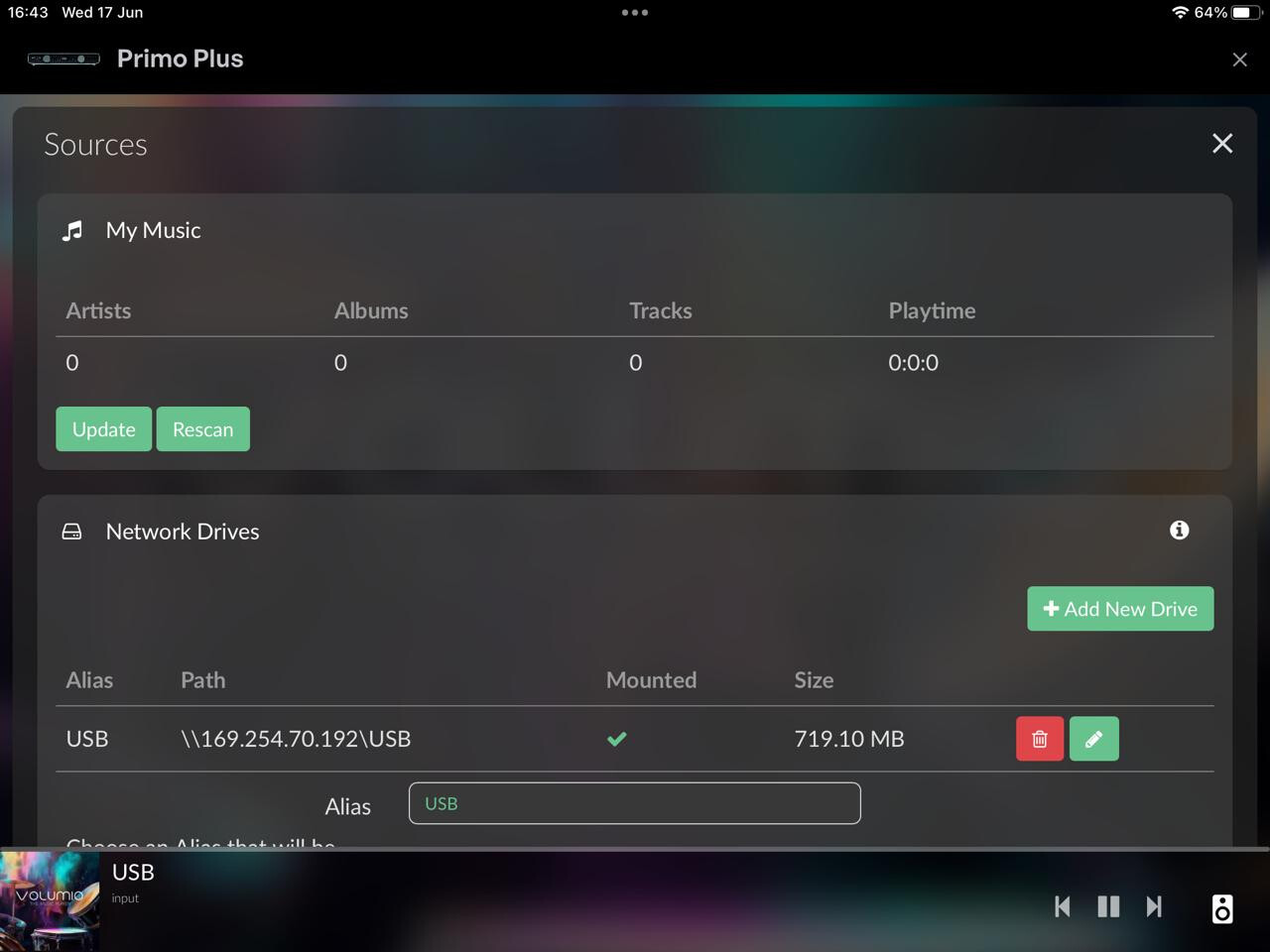
Please post a log, without it its just the Game Of Guessing.
- Perform a reboot
- When the unit is fully up and running post a log
- Place the generated URL in this topic.
Generate a log:
goto <your-devices-IP-Address>/dev

Copy and paste the URL in this topic.

Next hit the update under sources and when completed, post that log too.
First impression seems that your mounting the USB drive from a 2nd devices, but your CIFS mount is incorrect.
It’s a defect that happens to everyone in Wi-Fi, I’m still trying by cable.
The Primo Plus v4 image is now available to the public, and we’re also releasing the beta image for Rivo.
Keep the feedback coming!
Rivo:
Run V4.167 and V4.156 for a couple of weeks without issues.
Audio Path (Balanced):
Rivo (LPS) → E50 (LPS) → L50 → LETSHUOER S12 Pro
| Source | Result |
|---|---|
| NFS shares | Pass |
| CIFS shares | Pass |
| USB Drive | Pass |
| Tidal, Qobuz | Pass |
| Web radio | Pass |
| DSD64, DSD128, DSD256, DSD512 | Pass |
| DSD1024 | Fail, stuttering sound |
| FLAC/WAV 44k/16-24-32b | Pass |
| FLAC/WAV 48k/16-24-32b | Pass |
| FLAC/WAV 96k/16-24-32b | Pass |
| FLAC/WAV 192k/16-24-32b | Pass |
| FLAC 384k/16-24-32b | Pass |
| MP3, M4A, OGG, AIFF | Pass |
As I have just updated Rivo to (not aware of it was a Beta version) 4.156, frankly speaking I see no, actually NONE! of announced improvements, on the contrary> also with updated Ios 26 app, the UI is absolutely the SAME! as it was (poor visually, sluggish, comparing to i.e. Roon or Tidal/ Qobuz native apps), some pluggings missing/ unavailable (Now Playing completely vanished!), Internet radios favs gone/ erased, NAS folders/ My Library also gone (after warning that for Premium users were to have their libraries saved ''in the cloud?, what cloud, where is it???)…
WTH is this fuss about?
I sent the log using the “Send” button at the end of the report
To be quite honest, I did not know that this device would require expert IT skills to operate. The instructions supplied are quite simple - “Item 8 instructs me to connect a USB drive to the USB-A HOST and select NET”
Tapping the speaker icon at the bottom and choosing USB changes the display to USB. The only to get NET is to choose STREAMING.
Whatever is chosen, there is no content
The USB drive is connected with a USB-3 cable directly from the drive caddy to USB-A
I have no idea what you mean by CIFS. Again, I am not an IT expert
At the moment, the Primo Plus is doing about 10% of the job I purchased it for. The dealer is clueless or does not answer emails
If you cannot get it to work as is implied (very simply) in the instructions, I will put the device back in the box and get rid of it. I am getting fed up with it