[PLUGIN] Just OLED - stereo spectrum, levels and a clock on small OLEDs

Dear Volumionauts,

Yes, another OLED plugin. The store was clearly suffering from a shortage. Before anyone sharpens a pitchfork, an apology, in public and in advance.

To @supercrab, @balbuze and Adrian Rossiter: mpd_oled put a spectrum on these little panels years ago, and plenty of players still run it happily. To @Zhapox: your SSD1309 plugin is tidy and I have no quarrel with it. To @olivier_audiophonics: the Evo Sabre and RaspDacMini displays are yours and stay yours. To Ax-LED and Faster3ck: Pirate Audio owners are in good hands. And to myself, co-author of the Evo Sabre and RaspDacMini LCD plugins, who now has some explaining to do to me.

Just OLED is not a fork of any of these and does not replace any of them. If one of them already does what you need, keep it.

It is also not for proper screens. If you have one of those, Glass, Glass-evo, Peppy, Now Playing, Touch Display and Stylish Player are where you want to be. This is the postage-stamp end of the market.

What it is

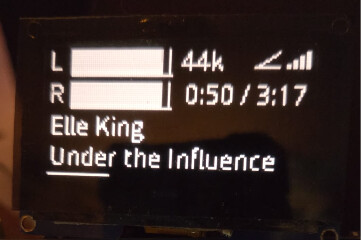
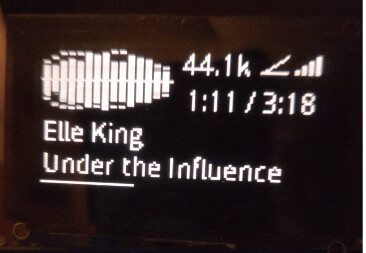
Spectrum, VU levels, the track and a clock on a small OLED, moving with the music. Under the hood:

  • an audio tap in the ALSA chain that passes every stream through byte for byte and measures it on a thread of its own: files, radio, streaming, AirPlay and Spotify alike
  • a small daemon that draws the pages over I2C or SPI, shows a standby clock and date with the player’s address, goes dark after a while, and puts boot, restart and shutdown messages on the panel
  • the usual Volumio plugin for settings and player state

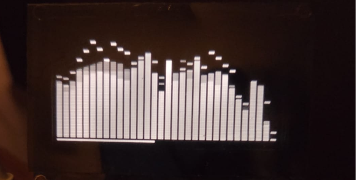
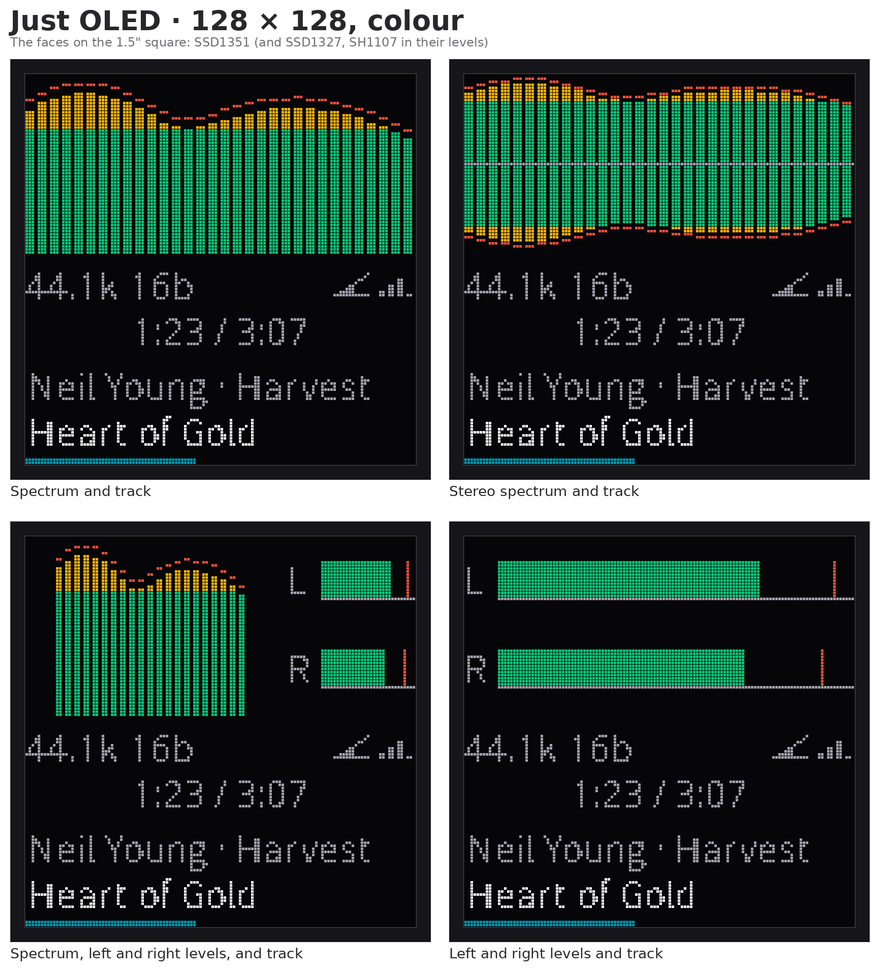
Faces: spectrum, stereo spectrum, spectrum with left and right levels, levels alone, the track alone in larger type, or the spectrum across the whole panel. Every page lays itself out for the panel it is on, from a 128x32 strip to a 256x64 greyscale or a 128x128 colour module.
What is new

I went through the Volumio 4 plugin sources before typing this: nothing else draws a stereo spectrum with left and right levels on one of these panels, and nothing else covers mono, greyscale and colour controllers in a single plugin.

The tap and the display daemon are written in Rust following the approach of my EVO Framework (https://evoframework.org): small single-purpose parts and a single external crate (libc). The approach only - there is no EVO code inside, and Just OLED is MIT licensed.

What it costs

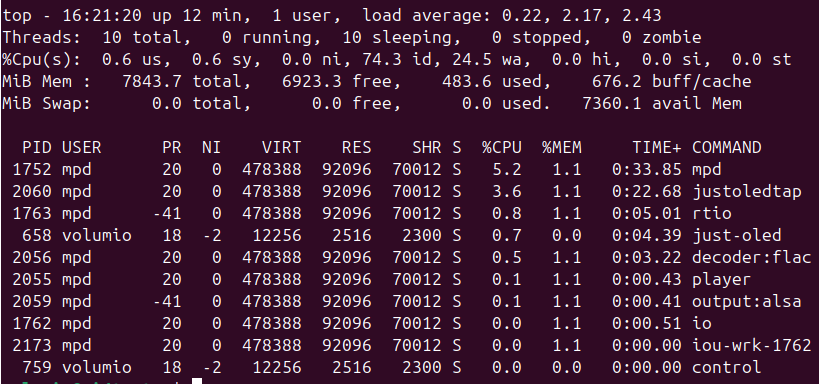
Measured on a Pi 4 playing FLAC, stereo spectrum with levels, all parameters up, [PANEL], with top -H over 10 seconds:

  • tap thread: 3.6% of one core
  • display daemon: 0.7% of one core, 2.5 MiB resident
  • together: about 1% of the Pi 4’s four cores

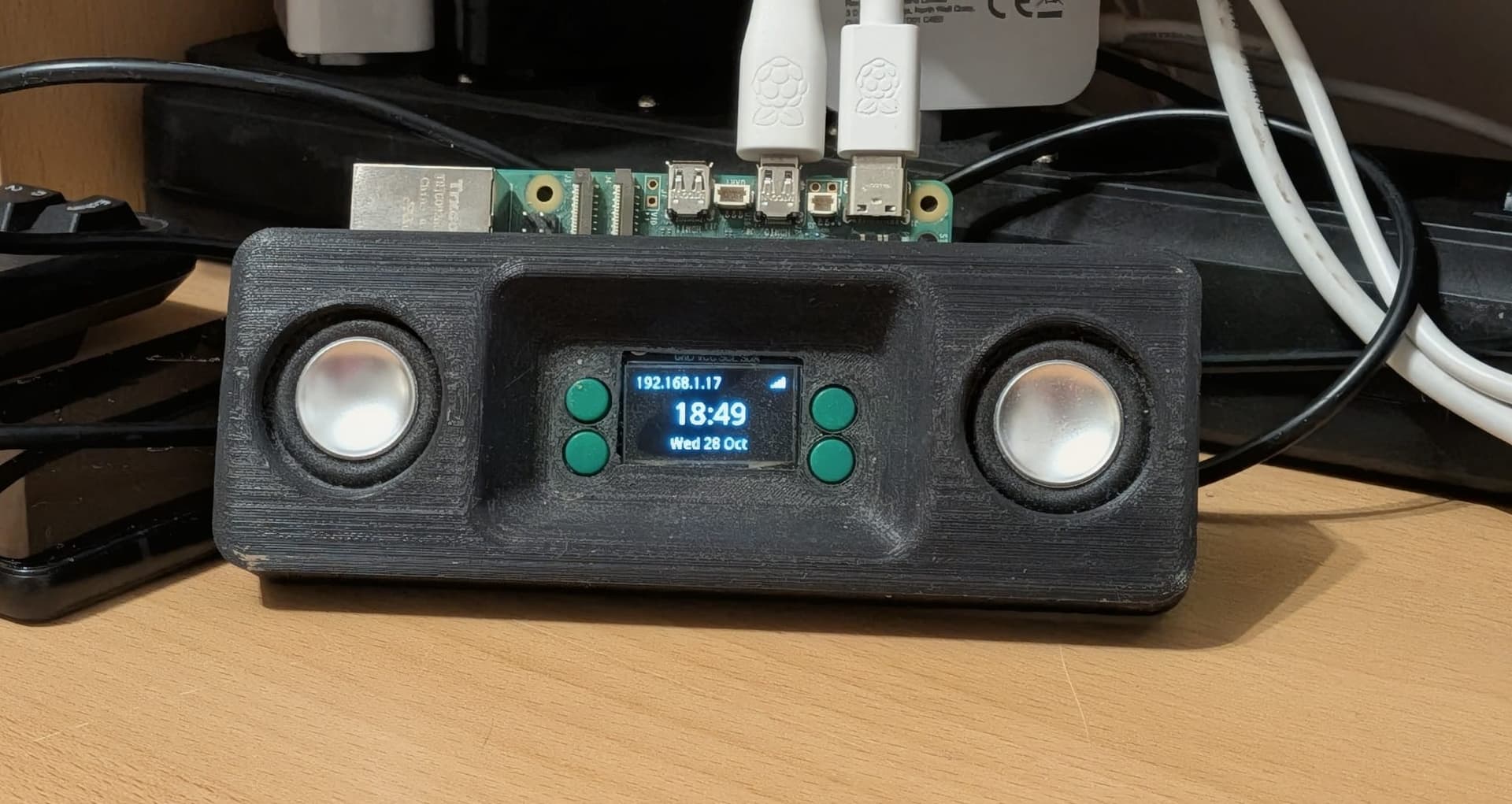
One thing to declare before someone finds it: the tap is an ALSA plugin, so it runs inside the player process. In plain top it is counted in mpd’s line; with top -H it shows as its own thread, justoledtap. The figure above is that thread, measured, not estimated. The screenshot below is from a Pi 4.
Where it stands

Version 0.1.3. The tap, the daemon, the faces and drivers for every common controller are in. One module has been seen working on the bench: the Waveshare 1.5in RGB OLED (SSD1351). The rest are driven from the data sheets, which is where you come in.

Controllers: SSD1306, SSD1309, SSD1315, SSD1305, SH1106, SH1107, SSD1327, SSD1322, SSD1325, SH1122, SSD1362, CH1120, and the colour SSD1331, SSD1351 and SSD1357.

Built to run on a Pi Zero 2 W, 3, 4 or 5 (32- or 64-bit image), or a PC with a USB I2C adapter.

Testers wanted

It is not in the plugin store yet. It goes there once it has been through field testing and Volumio’s review. Until then:

Most wanted: anyone with a panel other than the SSD1351, and anyone with a Pi Zero 2 W.

When you report, please include:

Displays, settings and troubleshooting are all in the wiki: Home · foonerd/just_oled Wiki · GitHub

Kind Regards,
Release record

Last updated 2026-10-31. This post is updated with each release; the full changelog is in the repo: just_oled/CHANGELOG.md at main · foonerd/just_oled · GitHub

Where Version How
Plugin store 0.1.6 Plugins, Search Plugins, Just OLED
GitHub 0.2.2 Releases, installed by hand as the Quick Start shows

In the repo and in the store

0.2.2

  • The ILI9341 draws the right way round; the first picture on a 2.8" board was a mirror image. Verified on a bare 2.8" board.
  • A TFT’s backlight pin comes in two kinds, and the settings page and the wiki now say which is which. A logic input (Waveshare’s BL, Pimoroni’s, Adafruit’s) goes to a GPIO and the daemon drives it. A pin that is the backlight itself (BLK or LED on the bare 2.8" ILI9341 boards and many ST7735 modules) goes to 3.3 V, never to a GPIO; a backlight that blinks with every update is that kind of pin on a GPIO. The Wiring page has the 8-pin board’s drawing.
  • SSD1306 128x32, SSD1306 128x64 and SH1106 128x64 verified over I2C.

0.2.1

  • On an I2C module at the Pi’s default 100 kHz, a setting saved or a track changed while music played only showed at the next stop or pause. Commands are now taken once every frame, whatever the bus takes. SPI modules and I2C at 400 kHz were not affected. Reported by Haslam on a Hailege 2.42" SSD1309 over I2C.
  • The store’s 0.1.6 still has this. Until the update reaches the store, set “I2C bus speed” to 400 kHz in the Connection section (a restart is asked for).

0.2.0

  • Larger type on the large panels: panels of 200 rows or more (the 320x240 and 240x240 TFTs) step every text size up one, 16/24/32 px in place of 12/16/24. The icons and level bars double with it, and the progress line is three pixels thick. The OLEDs draw exactly as before.
  • Standby clock in 64-pixel digits wherever they fit the width; a 12-hour clock shows am/pm beside the digits. Panels 128 pixels wide keep the old clock, since the big digits do not fit there.
  • Two new fonts in the binary: evo_32 and evo_64 (the clock digits).
  • The Screens page has the 320x240 colour pages.
  • After an update, the installer gives the restarted display the player’s current state.

0.1.9

  • A daemon restarted on its own (after an update, a crash or by hand) is given the player’s current state, instead of showing the boot text and then the clock until the next change.

0.1.8

  • After a plugin update the display comes back on its own; before, it stayed dark until the player was restarted.
  • The settings page saves every control it shows, including ones an update adds.

0.1.7

  • TFT LCDs over SPI: ST7789 (240x320, 240x240, 135x240, 170x320), ST7735 (128x160, 80x160) and ILI9341 (240x320). Only the rows that changed are sent, so the meter keeps 25 fps on the larger panels.
  • Backlight GPIO setting for the TFTs: lit while drawing, dark in standby.
  • Orientation in quarter turns (90, 270) for the TFTs.
  • An “SPI, Pimoroni HAT wiring” preset for the Pirate Audio and the Display HAT Mini.

Yes, Just OLED now drives LCDs. The name stays.

In the store (0.1.6)

  • 0.1.6 - the store lists the author as Just a Nerd.
  • 0.1.5 - the settings page in German, French, Italian, Dutch, Spanish, Polish, Japanese and Chinese.
  • 0.1.4 - a pause goes to standby after a set number of seconds (on by default); the plugin requires Volumio 4.
  • 0.1.3 - I2C bus speed setting (100 kHz, 400 kHz, 1 MHz); “Meter across the panel”; SSD1309 verified.
  • 0.1.2 - colour themes for the colour panels: Classic, Amber, Ice, Fire, White, or Custom.
  • 0.1.1 - the meter grows into the rows you turn off; “Track text” choice.
  • 0.1.0 - first release.

Verified on a module

Nine entries, covering every controller family the daemon drives:

  • SSD1306 128x64 - generic 0.96", I2C at 0x3C
  • SSD1306 128x32 - generic 0.91", I2C at 0x3C
  • SSD1309 128x64 - 2.42", SPI and I2C at 0x3C
  • SH1106 128x64 - generic 1.3", I2C at 0x3C
  • SSD1327 128x128 - Waveshare 1.5" greyscale, SPI
  • SSD1331 96x64 - generic 0.95", SPI
  • SSD1351 128x128 - Waveshare 1.5" RGB OLED, SPI
  • ST7789 240x320 - Waveshare 2" LCD, SPI - repo only
  • ILI9341 240x320 - bare 2.8" board, SPI - repo only, 0.2.2 and later

The store’s 0.1.6 drives all seven OLEDs. SSD1309 and SSD1351 were verified before 0.1.6 went into the store; the other five since then, on the repo version.

The other 20 entries are other sizes of these controllers, described from the data sheets. What remains unproven there is where the glass sits in the controller’s memory, not the driver. Three more are catalogued but not yet driven: SH1107 128x64, SSD1357 and CH1120. Reports from other modules are still the most useful thing you can send.

Kind Regards,

Subject: Request for ST7789 Display Support in Just OLED

Hi,

First of all, thank you for your work on the Just OLED plugin for Volumio 4.

I would like to ask if it would be possible to add support for displays based on the ST7789 240x320 controller to your project.

This would be a very useful addition for users who would like to use this type of display with Volumio 4.

Do you think it would be possible to integrate an ST7789 driver into a future version of the plugin?

Thank you for your time and for your great work.

Best regards

Hey @Haslam,

Thank you - yes, this is a good fit. The ST7789 is a 4-wire SPI controller taking 16-bit colour, the same path Just OLED already uses for the SSD1351 colour OLED, so the driver is a known shape; and it opens the door to its relatives (ST7735, ILI9341, the round GC9A01).

Two questions so the first entry is right: which module exactly do you have (vendor, size, and the pins printed on it, including the backlight), and would you be willing to test a build on it?

Entries ship as “described” until someone with the module confirms them, as happened with the SSD1309.

One thing to set expectations: the first step puts Just OLED’s faces - spectrum, levels, track, clock - on the TFT. Album art is a separate question with a separate cost, and I will say where it stands once the display itself works.

Kind Regards,

Hey @Nyverion4ad8ea,

First, a reminder: this forum uses English. Please post in English so everyone can follow.

On the substance: the difference you describe is the one the wiki already makes. The Displays page splits the catalogue into three groups: verified on a module, described from the data sheet, and catalogued but not yet driven.

Your post needs two corrections, plus one confirmation:

  • SSD1309 is verified, not just listed: a 2.42" 128x64 module, over SPI and over I2C at 0x3C.
  • ST7789 is verified at 240x320, on a Waveshare 2" LCD (ST7789V). This one is not under discussion; it is running on my bench. The other ST7789 sizes are described from the data sheet. The TFTs are in 0.1.7 and later on GitHub, not yet in the store.
  • SH1106 is described from the data sheet, as the page says.

I could strip the plugin down to the three modules I own, so the list and the bench match exactly. Or the people who own the other twenty-six could tell me whether theirs work, which is rather the point of this thread. Or you can send me the module, and I will test it and update the wiki.

If you have an SH1106 module, a report is welcome:

Kind Regards,

Hey!
Thank you @nerd for this amazing plugin!
It runs very well with BassFly µHat from @Darmur
It uses bassfly-uhat/pictures/OLED_module.jpg at master · Darmur/bassfly-uhat · GitHub


Out of the box! Install, enable, enjoy!
:grin:

Tested with:

OLED is detected automatically, only needed to configure the colors… (read like white)
Alle function from menu “While playing, show” are working, but need to stop playback every time before the setting takes place.

/edit:
Seems issue is only with i2c driven OLED’s. SPI driven OLED respond to save.
edit:/
image

image

image

Dear Volumionauts,

Just OLED 0.2.2 - the I2C fix reported by @Wheaten , four more verified panels, and what the bench found

The I2C bug is fixed (0.2.1). @Haslam’s report was exact: on an I2C module at the Pi’s default 100 kHz, a setting saved or a track changed while music played only showed at the next stop. The cause was arithmetic, not the controller. A 128x64 frame takes about 95 ms on that bus, longer than the daemon’s 40 ms frame period, and the daemon only read the plugin’s messages in the time a frame left over - which, while the spectrum moved, was none. The moment playback stopped the picture stood still, a frame cost nothing, and the queued save went through. SPI and I2C at 400 kHz never had the problem because their frames are shorter than the period. Since 0.2.1 the message queue is drained once a frame whatever the bus takes. Confirmed on the bench on a 0.96" SSD1306 at 100 kHz (93 ms a frame, the worst case): face change and track skip both shown at once.

While on the subject: the I2C bus speed setting in the Connection section at 400 kHz takes a 0.96" from 10 to about 22 frames a second, measured. Worth a try on any I2C module.

ILI9341 (0.2.2). The 2.8" boards drew mirrored - that controller scans the other way from the ST7789. Fixed; verified on a bare 2.8" board at 25 fps.

A TFT’s backlight pin, two kinds. Found the hard way on that same board. Some TFTs have a backlight pin that is a logic input (Waveshare’s BL, Pimoroni’s and Adafruit’s): it goes to a GPIO and the daemon switches the backlight with the display. Others have a pin that is the backlight - BLK or LED on the bare 2.8" ILI9341 boards and many ST7735 modules: it feeds the LEDs directly and belongs on 3.3 V, never on a GPIO. On a GPIO, or wired to CE0 by following a seven-pin OLED drawing, the whole glass blinks with every update. The Wiring page now has a section on it and a drawing for the 8-pin boards; the settings page’s help text says the same.

Verified panels now nine, one of every family the daemon drives:

Family Verified on
SSD1306 / SSD1309 / SH1106, 1-bit 0.96" and 0.91" SSD1306 (I2C), 2.42" SSD1309 (SPI and I2C), two 1.3" SH1106 (I2C)
SSD1327, 4-bit greyscale Waveshare 1.5"
SSD1351 / SSD1331, colour OLED Waveshare 1.5" RGB, 0.95"
ST7789 / ILI9341, TFT LCD Waveshare 2" IPS, bare 2.8"

The rest of the Displays list is other sizes of these same controllers; what remains unproven there is a glass’s place in its controller’s RAM, not the driver. If you have one of those - a 1.3" 240x240 ST7789, a Pirate Audio, a 256x64 SSD1322, an SSD1309 at a different size - the test picture tells in one look whether it is right, and a report either way helps.

Also since 0.1.9: after a plugin update the display comes back by itself and gets the player’s state within fifteen seconds; the large TFT panels set their pages in larger type with a crisp 64-pixel standby clock (0.2.0).

Release: Release v0.2.2 · foonerd/just_oled · GitHub

Now, the hard part - if you wish me to test further modules - send it to, or setup yourself and share results in this thread. I have no incentive in investing in more modules just for a sake of it.

Kind Regards,

Just to say THANK YOU.

I’m using a “modified” tuner case for my volumio, and I have both a SSD1306 OLED and a WaveShare DSI 11.9 displays working. Up to now, making the OLED display work in Volumio 4 needed sources to be complied and packages installed. Now it was a real plug-and-play. Everything is working (with Glass, of course) wonderfully. BIG BIG THANKS again. You are great.

Best regards.

Angel Luis Pérez Hernández

Hey @aluisperezh,

Thank you, Angel - that is very kind, and good to hear.

Plug-and-play was the whole aim, so it means a lot that it worked that way for you. Glass and Just OLED sharing a player in a tuner case sounds like a lovely build.

If you have a moment, tell me the size of your SSD1306 and whether it is on I2C or SPI, and I will add it to the wiki as a module seen working in the field. A photo of the case would be very welcome too, if you are happy to share one.

Thanks again for taking the time to write.

Kind Regards,

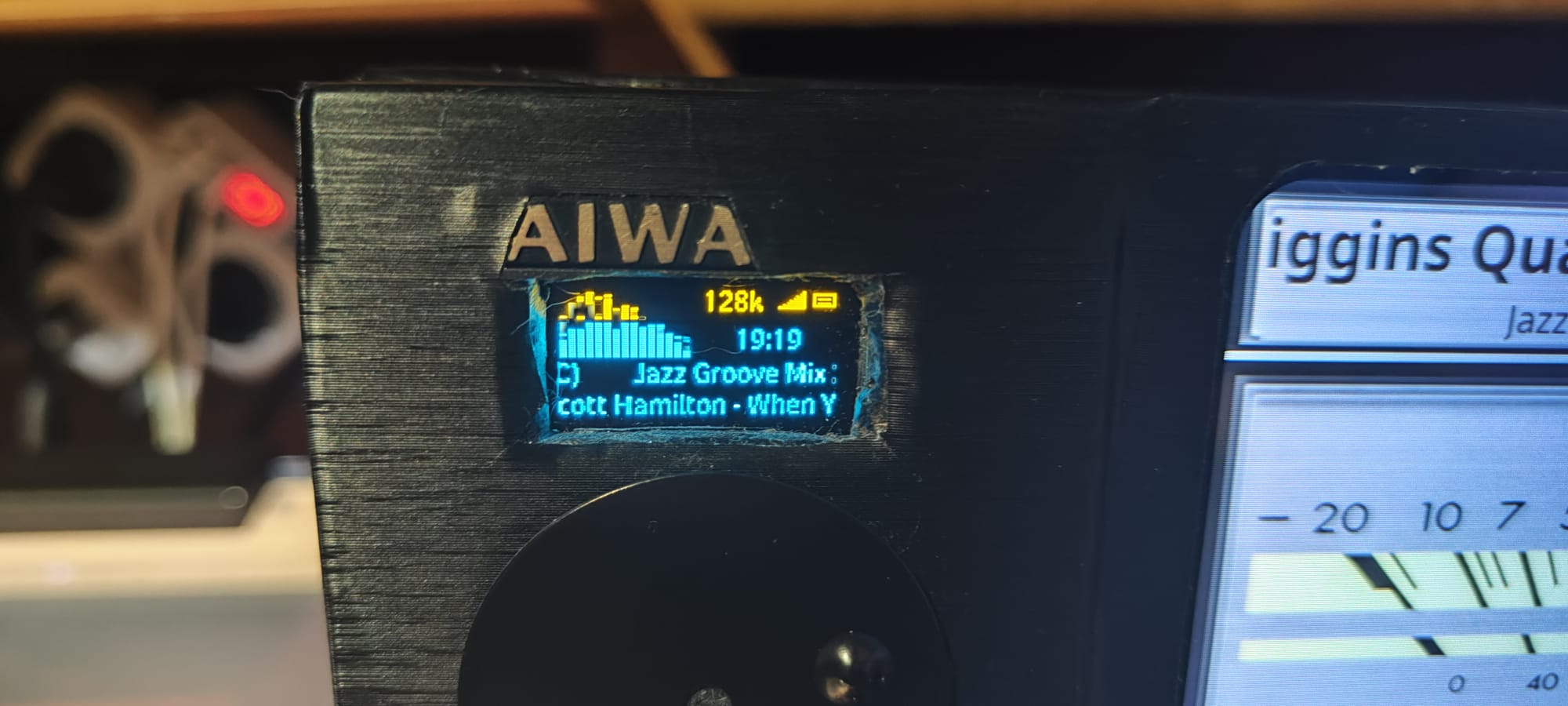
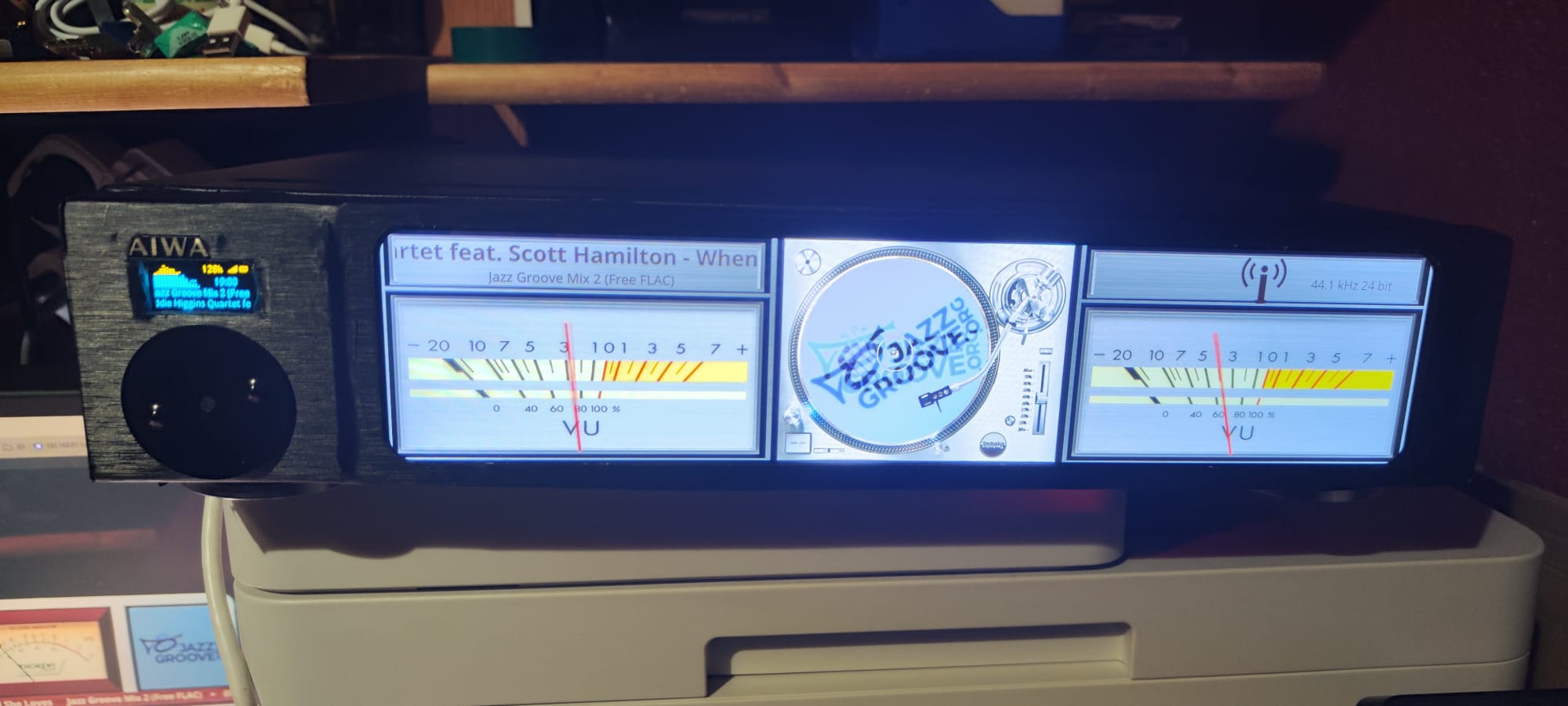
Well, I’m not very proud about the finished device, but it matches perfectly my ancient Aiwa HiFi system (I had a broken duplicate tuner around and adapted it for Volumio), which has an incredible sound after more than 30 years. I’m trying to design something else with my 3D printer, but I’m too old for that and too new in 3D :rofl: .

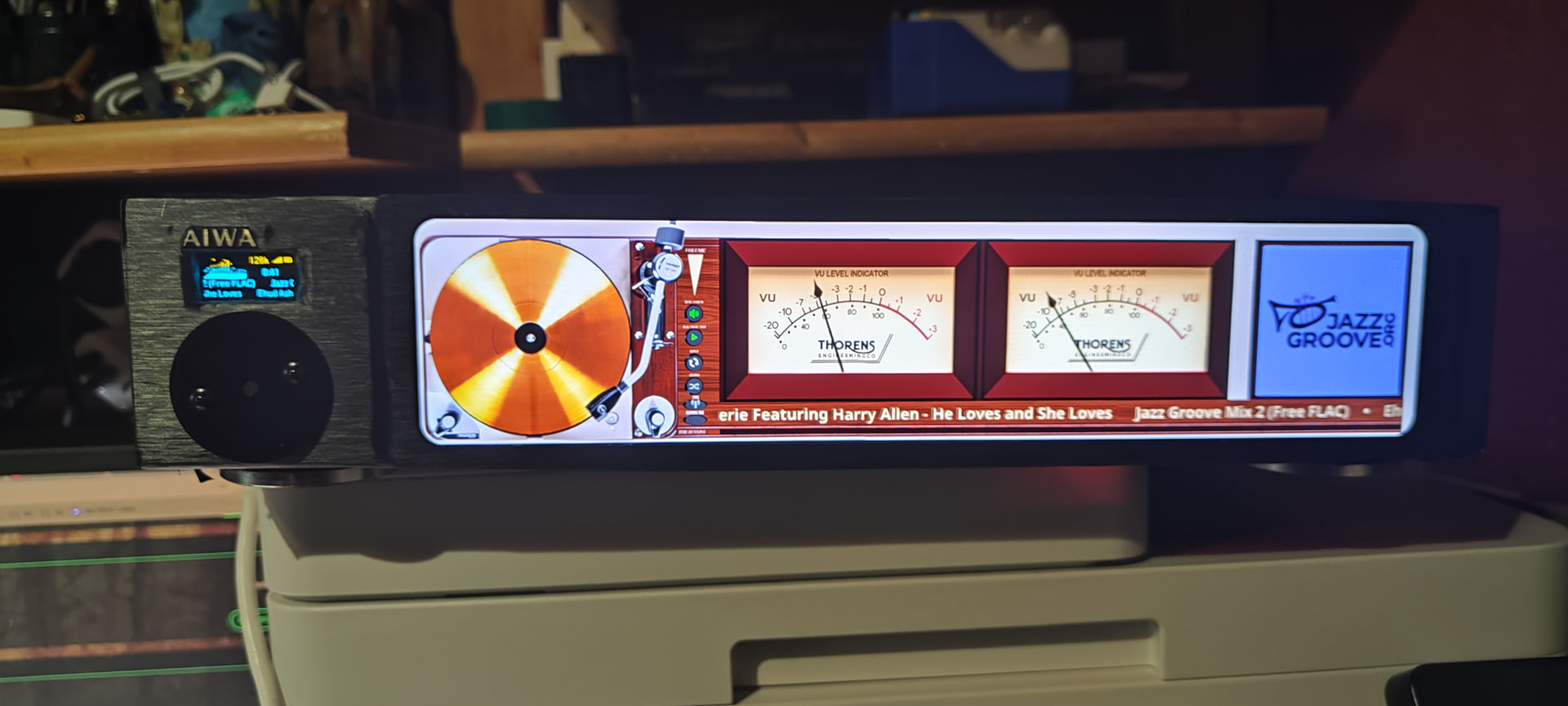
Anyway, here is a photograph of the system working. It lacks a smart button below the small display, which I left in the other house, and that makes it easy to manage from HomeAssistant.

The OLED display is a 0,96" I2C SSD1306 in blue and yellow, and the big one is a WaveShare DSI 11,9". It sounds really well and the display with Glass, Glass-Evo and Just OLED plugins is simply amazing.

And besides Volumio, all that is there because of your work. You made the DSI display work, you made the Glass/Glass-Evo plugin and now Just OLED. All I can say is THANKS.

Best regards.

Angel Luis Pérez Hernández